The Pacific plan for 2008
Cyclone season is December to March. Very occasional cyclones reach the Marquesas in March but have done so. According to the Hawaii cyclone data bank very few have reached the Marquesas in the last ten years (didn’t help us with Felix!!!!!!)
This means that we should plan our arrival in the Marquesas in the beginning of April 2008, to maximise our time in the South Pacific before we have to run for New Zealand to miss the start of the cyclone season in December. Galapagos – Marquesas (Cruz – Atuora) = 2971nms which is approximately 20 days sailing +/- @ 150 nms/day. This means departing Galapagos not before March 10th, 2008.
Allowing seven days for touring the Galapagos Islands this would mean an arrival there on March 2nd 2008.
Panama – Cristobal = 912nms which is approximately 6 days sailing +/- @ 150 nms/day, or 91/2 days @ 100nms/day. The cruising guide advises that the weather can be varied at this time of year and that we should leave with full tanks in case the wind does not appear, also that south or southwest winds are common, and if time permits, we should wait for the ITCZ to move north, however this is not a viable planning criterion. If we allow 9 days for the passage Balboa – Cristobel, then we should plan to leave Balboa on 23rd February or thereabouts.
Transiting the Panama Canal is any bodies guess by the looks of it but being optimistic I would suggest that we leave ten days for the transit (a week hanging around and three days to get through). By all accounts the hanging around is made most pleasant by visiting the San Blas islands. That would mean that it would be good to arrive in Panama on or before 14th February 2008.
Now before that I think we shall be there for at least a week to ten days so that we can be sure that we are organised – well as much as we ever are!
I wonder how the log will compare to the above????????
Refit
Curaçao
Once Sarah had returned home, I re-varnished the galley, Tom’s cabin, and the companionway. Varnishing is not easy when the daytime temperature is over 30C. During this time a gin palace in the Curacao Yacht Club caught fire and was set adrift Happily the wind was kind enough to blow it onto rocks on the island a few hundred metres away, because the damage it could have wreaked in the anchorage in Spanish Water doesn’t bear thinking about.
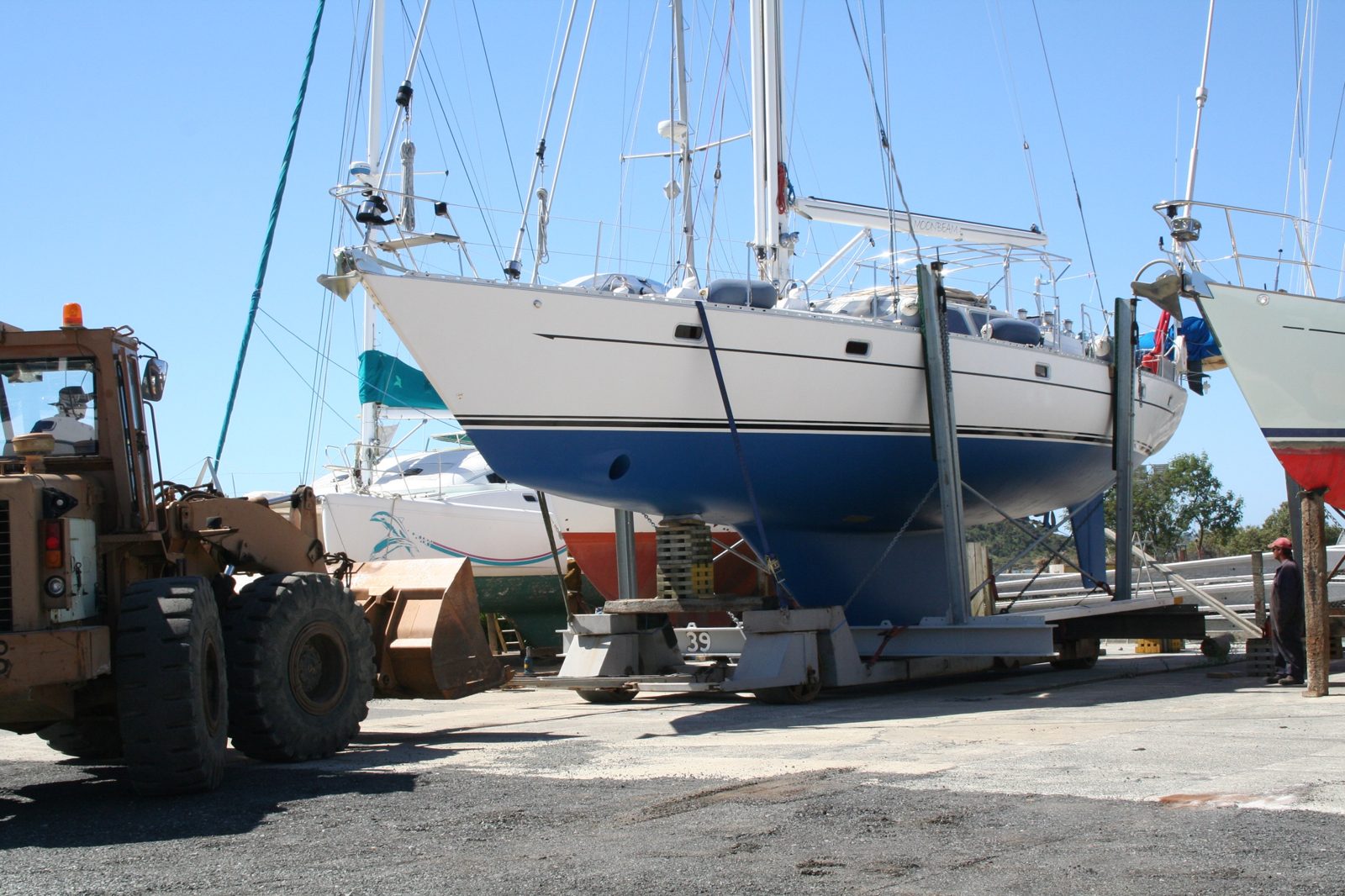
Once Moonbeam was ashore, her lines were scrubbed, rubbed down and re-painted. Her hull was cleaned and polished and 4US gallons of Awlgrip antifouling applied to her bottom. The antifouling had stood up fairly well in all but a few places, but her waterline areas were in very poor condition. I was able to download some pictures of my new granddaughter. I was yet to feel the joy of holding her as I was not returning until the end of the month.
The sea cocks were serviced, and the strainers renewed, and new hoses put in the aft heads. They had become calcified, and we had only just discovered why boats in the tropics carry so much white vinegar. Subsequently, the forward heads were serviced; all the stainless cleaned and polished. The max-prop was serviced, and new anodes fitted before I flew home to greet Eloise and have Christmas at home.
Relaunch, January 2008
We returned via a Miami night-stop in style on 4thJanuary, laden down with spares once again. Repairs to the sea cocks, heads etc. were completed, the hull and topsides polished and the galley sole re-varnished. The immersion heater was found to be the cause of an earth leak and the replacement flown out from England by Fedex cost more than our Miami night-stop! At last Moonbeam was ready for the water and she was re-launched into her natural environment on 11th January 2008 – in the sunshine!
A few days in Spanish Water allowed us time to make up our minds to miss out on Cartagena on the promise that we would visit on another occasion. So, on 19th January we set off for Panama with a benign forecast for the next five days.
Passage to the San Blas Islands
How wrong! This was my email to family and friends on our safe arrival in the San Blas Islands with 10,000 miles on the clock. Congratulations Moonbeam!
“We are safe and sound in the San Blas Islands in Panama. We arrived last evening after an exhausting 4 days having left on a good forecast weather window. However, we have done gales for this year, 2008 - I hope. Running before force 7 -9 for 36 hours was not much fun. There is a comment that hereabouts there are square waves. Nonsense I thought. Well wrong again! I have never seen such a confused sea. We were falling down a mountain in complete control and got side swiped by a monster from abeam – but regularly! Moonbeam doesn’t care and behaves impeccably but the rolling in the confused seas of Columbia has left its marks on our bodies in the form of multi-coloured bruises. It is said to be one of the 5 worst passages in the world – lived up to its reputation in spades and makes me determined not to attempt the other 4! For us, I learnt that the storm boards should have been in. Nothing should be left to secure ‘once we get going.’ Our tried and tested prepared meals for the first 3 days is essential, even with a cook who has a cast iron stomach. For the skipper we know that we should expect that ‘shit happens’ but I am proud of the courage and resilience of my crew and hope that she will take confidence in the experience. This passage has made me feel older and wiser than any before. I recognised that Sarah was frightened (she was not alone) yet she did really well. I think it will add to her confidence downstream. For us - thank you Oyster Marine for a sound hull and rigging.”
Notes: Running on bare poles in force 9 = 5 – 6 kts. A pocket handkerchief of Yankee in these conditions is much better for autopilot control than staysail alone. Mainsail, even with preventer is – potentially lethal. We had an uncontrolled a/p gybe, that was so powerful that it stretched the preventer to allow the boom to gybe – not nice and we now need some stainless repairs for the bimini!
A delightful few days were spent in Paradise amongst ‘Man Friday’ islands populated by Kuna Yala Indians. This was certainly one of the most beautiful areas we have visited this trip and deserved a much longer stay. We spent a few fruitful hours replacing the satellite cable for the third time in the vain hope it would improve our connectivity with the Iridium network (it didn’t). But, as the end of January approached and we had to be in Colon for the arrival of Jane and Willem Westermann on 7th February, we decided to leave the San Blas islands and set off for Portobello.
Portobello and Colón
One short stop ashore revealed a very, very poor town even though it is on the world heritage site listing. Even the locals take their outboards home with them at night. On then to Colon, to Shelter Bay Marina to see the departure of the Blue Water Rally yachts and the haphazard arrival of the World ARC yachts. Moonbeam’s previous owner was amongst them on Kealoha 8. Kealoha means ‘I love you’ in Hawaiian and was Moonbeam’s previous name.
It was time to start provisioning for the Pacific and particularly dry stores were acquired to supplement those obtained in Curacao. We also made contact with Toto in the Panama Yacht Club. He was to provide us with rental ropes and tyres for our transit of the Panama Canal. But that is for another story.
Into the Pacific
When we arrived in Shelter Bay Marina, we were advised that they could only put us up for a couple of nights because they were expecting the ARC boats. The Panama Yacht Club was full and so it looked as though we would have to move to the assigned anchorage off Colon. However, with the departure of the Blue Water Rally boats and the non or late arrival of the ARC boats, we were able to stay until our own transit was scheduled.
The downside of Shelter Bay Marina is that it is 15km from Colon. The road routes via the Gatun locks which have to be crossed so if a ship is arriving or departing the locks, up to 45 minutes could be spent watching them. This, of course was fascinating to observe how the lines were attached to the locomotives and how they manoeuvred them into the lock. The marina ran a courtesy bus at 0800 every morning to the main shopping area and supermarket on the outskirts of Colon. It returned at about 1130 but the taxi fare was only $15 and was more convenient when laden with provisions.
We were determined not to use an agent if we could avoid doing so. Consequently, we reported to the Port Captain’s office and duly waited whilst a new Zarpe was handwritten. This was free of charge, but only got us as far as Balboa, the other end of the canal.
The general advice not to wander around in downtown Colon was probably well founded because much of the area appears to be very poor and rundown. As a result, we went everywhere by taxi which was a very cheap form of transport. Anywhere within the city cost $1. Lunch at the Panama Yacht Club enabled us to meet Tito who was to hire us 4 x warps for $60 and 12 tyre fenders at $3 each although a collection charge at the other end in Balboa was a further $1. He advised us that we would have to have the warps on board for the Admeasurer’s inspection.
Duly laden with the warps we set off next day in search of the Admeasurer’s office. Now it would not be unfair to say that both the sailing guides we have for Panama are a bit short of useful information regarding the location of the Port Captain, Admeasurer and Immigration offices. This was no doubt because most people give up and use the (expensive) services of an agent, and they know where to go! Anyhow, after several wrong turns and misdirection, we finally found the Admeasurer’s office located in the Cristobal Signal Station. A very helpful American black woman who manned the counter took our details and told us to expect the Admeasurer on the following day, Saturday.
He turned up as promised and determined us to be 60 feet from pulpit to davits which meant that we were to have an advisor rather than a pilot which would have been assigned if we were more than 65feet. He spent an hour on board, mainly filling out forms, but he did ask to hear the horn blast even though he did not look at Tito’s warps. Having passed muster, we then needed to present ourselves at Citibank just across from the Port Captain’s office and pay the transit fees; a job planned for Tuesday.
However, the banks were closed on Tuesday for carnival and were not due to open again until midday Wednesday. I had already returned the warps to Tito pending confirmation of our transit, but we decided to have lunch at the Panama Yacht Club in any case and go to the bank afterwards when it had re-opened. Towards the end of our lunch, we were approached by two mature American ladies, hailing from Texas, who introduced themselves as Doris and Alethea, and who enquired if we needed line-handlers. Now it is a requirement for the transit that there are on board a minimum of four line-handlers plus the skipper, so given that when Jane and Willem arrived, we would still be one short. They appeared very pleasant and were clearly very keen to join us for the transit. Alethea had her own sailing boat, so we agreed. It would be true to say that I wasn’t really expecting to need them as the Admeasurer had indicated that we would almost certainly go through ’nested’, or alongside a tug. In either of these events only two line-handlers would be active.
Needless to say, by the time I had explained the procedure for getting a scheduled transit time, and trying to get Doris’s mobile phone to work, we arrived at the bank in time to see it closing for the day. We had hired a car earlier on in order to be able to drive to Panama to pick up Jane and Willem, so we decided to return the following morning when the bank opened for business.
With the transit fees paid we set off for Panama and located the port and shopping malls. Our guests arrived on time together with their luggage having had a very long day transiting via Madrid and Guatemala. The following morning, I telephoned the scheduler and was offered a transit on Sunday 11th February, in three days’ time, which we were delighted to accept. We needed to alert Tito for delivery of the warps and fenders and as we had the hire car for another day we went into Colon and explored the municipal market before having lunch once more at the Yacht Club.
On our way back we decided to follow the signs to Lorenzo fort and so began the first of what were to become known as the ‘Westermann Adventures’. The drive to the fort was through a tropical rain forest forming part of a national park. The fort itself, originally built by the Spaniards to defend the mouth of the Gatun River and hence Panama itself commands a fantastic view over the approaches. Although the fort itself has been sacked and re-built a number of times the ruined remains are spectacular.
The last use of the fortifications was by the Americans in WW2 and the gun emplacement still exists (it was never fired in anger). We discovered a George the First canon amongst the Spanish armoury around the fort – no doubt a left over from one of the English occupations. After tiring of this we then went for a walkabout in the rain forest under Jane and Willem’s expert guidance. We were rewarded with a troupe of howler monkeys crossing from tree to tree over our heads. Later on, amongst the fascinating flora we found leaf-eater ants and an agoti.
We returned to Moonbeam to find a note announcing that Doris and Alethea would be joining us at 1700 on Saturday. True to his word, Tito arrived bearing tyre-fenders and warps and we set about protecting our topsides from the possible damage in the locks. Our line-handlers pitched up as promised and we installed them in Tom’s cabin and over dinner we started to get to know our new guests. Doris and been through the canal before on a cruise ship and as we were later to discover thought she was going to repeat the experience. She had a heart of gold and gave birth to a new Moonbeam expression – ‘being Dorissed’. We were left with the impression that we were a charter crew and Sarah, and I should really have vacated the owner’s stateroom for the duration of her visit!
Panama Canal transit
Sunday morning was spent practising safe winch handling and throwing lines. Having been in the marina I had rather switched off, so when I ran the engine, it was to find I needed to drain and change the racor fuel filter. I then thought I had better check the navigation lights – only to find that the starboard light had gone open circuit! I had to do a quick jury-rig to get it going. Even so we set off after lunch in ample time to meet our scheduled rendezvous with our pilot who was due at 1600. He actually arrived with a colleague under training at 1800. The schedule had slipped, and we were not due to go through the first lock until 1930. There was much confusion because we had the impression that we were to go through in a nest, and indeed that is what our pilot was trying to negotiate with the two other pilots on board the other yachts. On the run into the first Gatun lock the nest was on and off half a dozen times and it was only as we were approaching the lock gates that it was finally confirmed that we were to go through individually in centre chamber, This meant that all four line handlers would be needed.
My concentration was tied to the tanker in the approach channel that I could almost touch on my port hand side. At the same time my pilot was insisting on a speed over the ground to make good the timing into the lock. All this was done with rather poor communication because his English or my understanding of his English was not very good. Nevertheless, we arrived in the first chamber and as we approached all that we had read (probably too much) about needing hard-hats to protect us from the line-handlers’ monkeys proved to be nonsense. The line-handlers threw their monkeys over the boom and foredeck with skill, and they were easily captured, and our warps attached. Our reading had created an unwarranted level of concern.
We moved sedately under full control through all the Gatun locks into the lake and overcoming some language difficulty we subsequently moored to a buoy to await the arrival of the next pilot due at 0600. It was very late by now and so by the time Sarah had served the coq-au-vin we were all exhausted. I rarely see Sarah incandescent these days but her response to Doris’s “I don’t eat dark meat” was a moment to savour!
Well as luck would have it the next pilot arrived at about 0800 and was just brilliant. His English was excellent and his knowledge and enthusiasm for the canal and environment was very evident. We gently meandered through the Gatun Lake and saw our first sloth in the most unexpected, fabulous virgin rain forest. What a treat! We joked that we would demand a refund if we did not see an alligator. I don’t think that any of us had fully appreciated that most of the canal is in fact a lake formed by flooding the rain forest. The amazing thing is that you round a bend in the channel and come face to face with an enormous tanker or container ship. By this time, we had read ‘The Path between the Seas’ which had been recommended by Tony from ‘World Citizen’ who had a one-time been a canal pilot. The history of the building of the canal is fascinating – all the more so when you are in transit..
As we approached the Miafores lock our pilot alerted us to the fact that we would be on the canal’s webcam. Frantic telephone calls were made, and text messages sent but in the end we were 30 minutes late into the lock and only Gemma got to see us going through. Two more down locks and WE WERE IN THE PACIFIC – how fantastic is that? We cruised around the Balboa Yacht Club and our fenders and warps were duly collected. Eventually we were able to tie up on their fuel dock and say fond farewell to our Texas line-handling guests.
We bunkered some diesel and set off for the anchorage because there was no room either at the Yacht Club or in the new marina. When we finally got into the marina, I was pleased they had been full because their charges would put Berthons to shame!
Onwards to the Galapagos Islands
Much of our thinking to date had centred on the passage through the canal, but now it was time to plan the next part of our voyage in detail. A planning meeting was convened, and a decision was made to route via the Las Perlas islands having firstly explored one of the Rias to the east near the Columbian border. We allowed ourselves a few days to discover Panama City and took a forest tour early one morning that routed alongside the canal. Provisioning went on apace as we tried to forecast our needs given that we would be a crew of four until our departure for the Marquesas after Willem and Jane left us in the Galapagos, and we would need to plan for at least three weeks for that passage.
Willem and Jane went to the fresh fruit market and returned with a barrow full of fruit and vegetables which were so fresh that we were still eating some of them when we arrived in the Marquesas. We filled the freezers based more-or-less on what we had learned on our Atlantic crossing and obtained as much beer at $12 a case and wine as our forecast consumption calculated. However, it was during one of these forays that a casual conversation with some yachties caused us to scrap our planned routing and re-think it. They had not been as impressed with the Las Perlas as the sailing guides indicated they should. The water was cloudy and there were prettier places to go to. They suggested that we routed to the west to Isla Coiba which was anyway en-route to the Galapagos Islands.
I popped into the (Admiralty) chart agents near the quay and purchased a paper chart covering that area along with some tidal atlases and the nautical almanac for 2008. I had, of course largely ignored tides for the best part of a year. Our plotter chart already covered that area and also included the Galapagos. I had already brought out most of the charts we needed to get us as far as New Zealand in January but did not realise that the Galapagos was known as the Archipelago of Colon, so we had been missing coverage of the entire area of the Galapagos! However, Willem and Jane had brought it out with them and so we were now ready to go.
We had a wonderful meal in the city and several good lunches around the marina complex and so once we had topped off our fuel, we finally set off to cross the Pacific on Tuesday 19th February.
Isla Coiba and the equator
The winds were very light as reported that they often are at this time of the year and we consequently had to motor most of the way. This voyage was the first for Willem and Jane to be out of sight of land, so we decided to split the night watches, me with Jane and Sarah with Willem, to settle them in. During daylight hours we were offered a taste of what was to come. Firstly, we spotted a whale prior to a send-off fly past of pelicans. Willem caught a fine mackerel tuna, and this was all on the first day!
As we were approaching Isla Jacobon just south of Coiba where we planned to spend our first night, we were welcomed by a school of dolphins corralling their supper with a magnificent display leaping out of the water and hitting the surface with their tails. We had seen manta rays jumping out of the water – they seem to either jump in pairs one after the other or make two separate jumps so if you miss the first one you catch it on the second. The water was alive with sea snakes and turtles – what a treat.
We set a second anchor in about 10m and the following day discovered the outboard had water in the carburettor again. It had started giving problems in Panama so whilst I was stripping it down, Jane and Willem took the kayak ashore to the beach and set off for a nature walk. I suppose I should have alerted them to the state of the tide (which was coming in). It left me with a race against time to fix the outboard or don mask and fins for a long swim so I could reach the kayak before the tide!
The following day we crossed to Coiba escorted by dolphins once more. We anchored off a glorious bay which Willem and Jane explored in the dinghy (now working) and reported finding a marked trail into the forest.
Now you would have thought I had got into the swing again of making routine tidal calculations, but when we set off for our walk we tied the dinghy to a stake and waded ashore to find when we returned that it was aground about a mile away from the water’s edge! But our walk into the forest was spectacular and once again we were privileged to enjoy Willem and Jane’s encyclopaedic knowledge of wildlife and vegetation.
Isla Coiba is a national park and in the evening some park rangers came to see us. We told them of our intention to make our way up to the Ranger Station the following day, but we stopped along the way at Granata d’Oro to swim and snorkel in some lovely clear waters. The rangers visited us again in the evening to check up on us but more probably in the hope of another beer, and we duly turned up at the Ranger Station the following morning. Sarah, Willem and Jane went in to pay the park fees and found to our delight that it included a guide for a walk across the island through the rain forest.
I had followed them ashore in the kayak, but not without incident as I managed to turn turtle on boarding it. As a result, I lost my shorts, T-shirt, belt and leatherman in about 7m. The water was crystal clear, so I marked the spot and planned to search for them later on. So, for now – no leatherman! We had not gone ashore prepared for a walk, so I returned to the boat to retrieve some more appropriate kit. Once we had changed, we set off with our (garrulous) English speaking guide, who himself took along a local Indian guide. This was just as well because he clearly didn’t know the way through the forest! Coiba had until recently been a penal colony and so once we were off the track, we were in a spectacular virgin rain forest, where we spent the next few hours crossing the island. The wildlife and vegetation were absolutely amazing. We finally walked through some mangroves out to a bay fed by a small river. You should know that the park rangers had previously advised us of the flourishing crocodile population on the island, and we knew that a couple had spent the night in the mangroves here having got lost a few days before. In addition, our guide’s radio with which they were trying to raise their colleagues to arrange for a boat ride home was receiving only static.
By now, of course, it was getting late – the tide was coming in – no one was talking to us on the radio and our English-speaking guide was clearly a bit rattled. Willem was completely unfazed by this, but you know what I am like. It is just not in my nature to be comfortable relying on other people – particularly since there did not seem to be a contingency plan. The ranger’s assertion that we needn’t worry because their colleagues would come to look for us just didn’t seem to be very reassuring. Well, it was obviously too late to walk back through the forest so if we were not picked up we would have to spend the night in the mangroves with the forest creatures not to mention the crocodiles for company. I caused much hilarity by making a bow to turn a stick to light a fire, something I had seen done but not tried myself. This was not easy (no leatherman remember) and Willem thought I was just fashioning an arrow with which to shoot the guide!
However, happily my efforts were not needed as we eventually heard an outboard engine in the distance and we were duly picked up and taken back to the Ranger Station. It is interesting that none of us would have set off in the right direction if left to ourselves as we had become totally disorientated in the forest. The guides invited themselves for a beer and a Moonbeam T-shirt in the evening and we set off for Isla Cebeco the next day. Isla Cebeco was about 30 miles away and had its own whale and a ship parked in the bay from which we could bunker some fuel before setting off for the Galapagos.
The 750nms Isla Cebeco – San Cristobal took us 4 days 20 hours in predominantly calm winds and glassy seas, and we had to motor for a total of 73:45 hours. We caught one dorado but lost three lures, so it was as well that we were not relying on our fishing skills to survive. We crossed the equator on 2nd March at 2242 UTC at W088 19.8 and celebrated with a glass to Neptune, a glass to Moonbeam and a glass to us! Apart from the marine life, escorting gulls, a half-sunk wreck and a couple of ships we had been alone once more. When we anchored in Wreck Bay, Isla San Cristobal, it was 0900 on 3rd March and there commenced our Galapagos adventures.
An update to our journal is many months overdue, but for some reason I just haven’t felt in the mood to sit down to write it. However, at the moment we are confined in quarantine here in Suva, Fiji until we can be cleared in after the weekend and so there is no better time to catch up.
Wreck Bay, San Cristóbal
We anchored in Wreck Bay close to ‘Mariah’ which is a large catamaran on a leisurely delivery trip from the Seychelles to Tonga and last seen in Panama. We were amused to see a sea lion fast asleep on the sugar scoop of one of their hulls. This was to become a common sight and we were soon to have several of our own squabbling over who had sleeping rights on Moonbeam’s sugar scoop.
In fact, as soon as the dinghy was in the water it was adopted as a sleeping platform by anything up to three of these fascinating creatures. They were most indignant if we wanted to borrow the dinghy to go ashore and one of them when shooed off one side of the dinghy promptly swam under it to endeavour to climb back on the other side. It was wonderful entertainment throughout our stay in Wreck Bay – that is apart from having to clean up after them! They were obviously doing very well on San Cristobal, because there was a large colony resident on one of the beaches and indeed draped all around the small town of Puerto Baquerizo Marino. You had to step over or past those of them choosing to sleep on the dock when going ashore. They are such ungainly creatures on land but so graceful and acrobatic in the water.
When we went ashore, we were met on the dock by Fernando and his two camp followers. Fernando was San Cristobal’s Mr. Fixit and he was to be tripped over anywhere and everywhere we went. We had already talked to one of ‘Mariah’s’ crew about the snorkelling trip that he had been on to Kicker’s Rock and swimming with sea lions and so we duly booked a trip with Fernando’s brother/cousin/other relative who ran a dive shop for the following day.
I was anxious to check-in and so started our interaction with Ecuadorian bureaucracy. The Port Captain’s office was staffed by Ecuador navy personnel, none of whom spoke very good English, so we had to manage on Sarah and Jane’s Spanish. We were sent away until after lunch and on our return were confronted with a flat refusal to check us in without an agent. Consequently, the rest of the afternoon was spent tracking down one of the two agents reported to have offices in town.
Eventually we made contact with Johnny’s sister who had a desk in a small grocery store. Now Johnny operated out of Puerto Ayora on Santa Cruz, and we had exchanged many emails over the previous six months as he tried to persuade us to use his services, and we tried to make up our mind whether or not to use the boat to explore the islands. This had been discounted as an option when we discovered it would cost at least $1000US per day. His fee for agency was $300US to act for us and obtain a Zarpe (cruising permit), which I was unwilling to pay. We settled after much haggling on $150 which was paid to his sister. For what was actually done by both him and his sister rather than by me, it proved to be $150 too much!
However, having engaged the services of an agent, we arranged a rendezvous at the Port Captain’s office for the day following our snorkelling trip. Meanwhile, Fernando had taken our passports to immigration and returned them to us duly stamped for a small fee when he found us having a beer at a café on the front. The dive boat duly picked us up the next morning. It was a combined trip with the four of us snorkelling and eight or ten others going for a dive. The dive boat was a catamaran with two (different) outboard motors and a cabin fore and aft of an open well in each hull. It had a large flat deck between the hulls forward of the cockpit which was situated in a well aft. We had a good trip out to Kicker’s rock with a stop for us to go snorkelling whilst the divers did a weight check.
Kicker’s rock is a small island 100m or so high, split into two by a cleft which was 15 to 20 metres deep. The divers were briefed that they would be dropped on one side of the island and to go through the cleft with the tide and the boat would pick them up on the other side. We were to follow the same guidelines but on the surface. Sarah was not keen on this but Jane, Willem and I set off for a magnificent treat. Below us in crystal clear waters were white tip and hammerhead sharks cruising amongst shoals of reef fish and rays – what an incredible sight!
On our way back after lunch and a second dive the wind picked up sharply and water started to break over the boat. No problem for the flat deck between the hulls, but as the anchor locker in the starboard hull had no cover and sufficient water was coming aboard to fill the wells in between the open cabins and spill into them, we duly started sinking with a marked list to starboard. At first the dive master (Fernando’s relative) seemed unconcerned, but he suddenly woke up to the danger. Although the divers all had BCDs, I couldn’t find any life jackets in the area so marked and the bilge pump had a capacity of about a litre a minute, so the cockpit was filling up too. Now don’t forget that we had come 11200nms in Moonbeam, a thousand of which Jane and Willem had been with us, so the thought of being shipwrecked on an un-seaworthy dive boat was unappealing to say the least. The dive master had the good sense to slow right down and head towards the shore which although rocky could have been a refuge in extremis. At the same time, we all moved aft to the port quarter whilst the crew bailed with an energetic urgency seldom seen in the natives. Others held cushions up at the bows to try to reduce the inflow of water and we finally made it back to the cove where we had stopped on the way out. Not to be phased by this (and after all it was on the itinery) we were dispatched overboard to swim with the sea lions whilst the crew continued with the clean-up. The sea lions were wonderfully playful and so graceful in the water. They did not seem to mind us being amongst them and they would twist and turn very close by, but without touching you. And so, another Westermann Adventure came to an end.
Clearing in took several attempts and the whole of the following day. I parted with port fees, light, harbour, and buoyage fees together with a fee for the fumigation certificate even though no one had come to the boat let alone fumigated it. This was all done with Johnny’s sister in attendance but not actually doing anything!
To lighten things up we watched the antics of a heron perched on the anchor chain picking off fish as they swam by. Pelicans also had a use for the boat by swimming alongside the hull and scooping up fish in their bill when they were corralled against it. We had arranged with Fernando for a large delivery of fuel, and he duly pitched up with his entourage and a selection of battered containers from which the fuel was siphoned into our tank. It was just as well that I had a good stock of fuel filters!
The next day was spent on an island tour, firstly through their coffee plantations and then on to a conservation area to see giant tortoises. An effort to breed them in captivity was having some success and when they were big enough, they were due to be released and returned to their natural habitat. When they were little, they were protected in the conservation area from predators (such as rats) that had been introduced to the islands. Next stop was for coffee at a plantation house. Unfortunately, there was no hot water for coffee because the plantation owner had run out of matches to light the gas. You will remember that Willem had been laughing at my attempts to light a fire when we had been abandoned on Isla Coiba, so it was with great pleasure and endless amusement when I was able to rummage in my rucksack and find a lighter! Coffee was back on!
Our tour took us next to a ‘Swiss Family Robinson Tree House’ that the locals were obviously very proud of and then on to the coast near the airport where, when you looked closely, you could make out marine iguanas camouflaged on the black lava rocks. These pre-historic reptiles were sunning themselves to warm up sufficiently to be able to go into the water to feed until it was necessary to return to the rocks to warm up again. Finally, we were taken on to Fernando’s house where his mother, wife and half a dozen other relatives provided us with lunch. All-in-all it was a very interesting day to end our stay in Wreck Bay.
Puerto Ayora, Santa Cruz
It was only 40nms or so to Puerto Ayora so we departed at 0230 and dropped our anchor in Academy Bay at 0900. The bay was crowded with ARC boats which were shortly to leave and so we put out a stern anchor in common with most others. We tried calling Johnny, but it was a weekend, and we got no response so we spent the day exploring the town and watching the antics of the pelicans and the extraordinary aerial display of the blue footed boobies. Ashore, Jane and Willem booked a dive and we all dined at the Red Mangrove on the recommendation of a local resident. We had a magnificent sushi and sashimi meal which turned out to be Jane and Willem’s introduction to this Japanese feast.
On the Sunday, Jane and Willem returned from their drift dive saying that it was the best dive ever. They had been among white tip and hammerhead sharks and Willem had taken some amazing underwater photos. Meanwhile Sarah had made some new fender covers from the material that Jane and Willem had kindly brought out with them from London. As she was sewing the last cover the sewing machine caught fire and when I took it apart, I found that the electronics had disintegrated. I planned to use it as a spare anchor or at least send it down to Davy Jones’s locker, but Sarah insisted we should take it to New Zealand with us and find an Elna repair agent. I wonder if we will.
We went in search of Johnny on Monday morning and the only really useful service he provided was to change Jane and Willem’s booking so that they could leave a day later. We found the municipal market where meat, fruit and vegetables were sold and the open-air fish market which was on the front. The fish market was surrounded by waste disposal facilities in the form of a flock of pelicans that fought over the discarded remains as the fish were cleaned. The fishmongers also had what looked like a tame Labrador under the fish counter, which on closer inspection turned out to be a resident sea lion greedily scooping up scraps.
We booked to go on a tour to Bartolome Island and caught a water taxi at the crack of dawn to take us into the dock where we were picked up by a coach to take us across the island. From there we were taken out to a boat and given a welcome breakfast before a three-hour trip to Bartolome. This was the first opportunity to get a close look at one of the tour boats and like many others we saw, it had seen better days. That said at least it had life jackets aboard! Our guide led us up the wooden walkway that had been built to shepherd the constant flow of visitors and protect the wildlife growing on the lava rock to the top of the hill overlooking the lava flows. It was the picture featured in all the Galapagos literature and looks like a primeval moonscape. There were three or four other tour boats in the vicinity, and we couldn’t help thinking that we were being herded from place to place. We caught sight of one penguin when we went snorkelling at the appointed time and place on a nearby beach and after lunch on board, we were returned to the dock by 1630.
The next day was spent catching up with chores and packing before our final meal together in the Angermayer Point restaurant, for we were sad to have to get up early to say goodbye to Jane and Willem. We were so sorry to see them go after five weeks together with a shared experience of a lifetime. It had been a lovely way to renew our friendship and we couldn’t have had more fun if we tried. It was altogether an outstanding success. They are so knowledgeable about wildlife that it was like having our own tour guides on board. They had been perfect boat guests and most generous in sharing the chores and cooking as well as the expenses of running the boat. We just hope that they will be able to join us again in the future.
As ever we felt very ‘flat’ to be on our own again and so we consoled ourselves by having several lunches on the deck amongst the marine iguanas at the Red Mangrove, and where we could watch the pelicans and boobies. The mangroves in which the restaurant was set surrounded a small cove around which the pelicans had made their home. It appeared that the cove was a flight-testing area for young pelicans for whenever they came in to land, they invariably tipped forward onto their heads – wonderful! On one occasion a two-metre shark nearly beached itself chasing an unlucky fish into the cove – all overlooked by herons standing majestically and perfectly still.
Our melancholy was relieved by the news that Annabel and Tom had booked flights to Tahiti arriving on the day Gemma and Eloise were departing having spent the previous two weeks with us. What a lovely thing to be able to look forward to. We visited the Charles Darwin research station and saw ‘Lonesome George’ the last giant tortoise of his gene pool along with many of their conservation activities. Altogether we stayed for another week after Jane and Willem left us and picked up a resident pelican as well as a family of metre long black tip sharks that made their home under the boat. The blue footed boobies put on their flying display most days and especially when the water had been cleared by overnight rain. What a fantastic place! Saturday dawn had us at the farmer's market, but we had gradually got fed up with provisioning and decided to leave with what we had - I am sure we won’t starve! We lifted the dinghy, serviced the engine and generator and after many visits to Port Captains, Immigration and the offices of the agent and paying yet more port fees, we were ready to depart with a Zarpe (cruising permit) and a stamp in our passports.
Having read (probably too much) about visiting the Galapagos in a yacht we found the whole check-in/out procedure haphazard and talking to others somewhat idiosyncratic. We were forced to have an agent and, in the end, stayed for nearly three weeks. We were restricted to Wreck Bay on Isla San Cristobal and Puerto Ayora on Santa Cruz and did tours from each place. As far as we can see, it is apparent that the restrictions placed on yachts in the Galapagos Islands are more about getting money than about conservation, so with that in mind I decided to trust my instincts and insisted on paying the park fees for all of us, personally, at the Charles Darwin research station. That way we could at least be sure the funds reached the right place. Otherwise, it seems a most haphazard way of collecting fees from visiting yachts. That all said we would not have missed this opportunity for the world. The wildlife was unbelievable. The fact that we could get within feet of the marine life, animals, and birds without seeming to scare them was a privilege beyond dreams and apart from the bureaucracy the people we met were friendly and helpful. But now it was time to leave for the next part of our adventure.