Leaving French Polynesia
After long consideration and debate, we decided to head for Rarotonga in the Southern Cook Islands and then to Tonga en-route to Fiji. This is because it looked like we would not get into American Samoa (Pago Pago) because they have decided that the visa waiver scheme no longer applies to blue water yachts or private airplanes. Ulf from ‘Roxy’ had alerted us to this information that was posted on the ‘Noonsite’ website which is Jimmy Connors’ electronic means of keeping everyone up to date. However, we later found out that American Samoa was not applying the rules, but it was of no consequence to us because we had changed our plans, which in the end we believe were to be for the better. A couple of days of light winds preceded a flat calm so we furled the sails and put the table up in the cockpit and had a civilised lunch. We then motored for 20 hours or so until the wind was due to pick up. However, when I tried to move the throttle control, I discovered that it was stuck with the engine turning at 2000rpm. I assumed that the throttle cable had become jammed, so I stopped the engine, and as it was midnight and there was absolutely no wind, I decided to let the boat look after herself and went to bed.
Two hours later the wind picked up and we were sailing again and, in the morning, I investigated the control problem and discovered that it was not the throttle cable. There was something broken inside the fuel injector pump which I didn’t want to take apart until we were somewhere where I could get a spare if we needed one. So, it's either full ahead or full astern and having to stop the engine in between! Not ideal for manoeuvring a short-handed yacht this size in a small harbour which is all Rarotonga has to offer. As a consequence, we decided to head on to Niue and if we couldn’t get on a buoy (knowing that we couldn’t anchor there), we would continue for another couple of hundred miles to Tonga where we had previously chartered a yacht for our 25th wedding anniversary.
Landfall at Niue
Six days out and we should clock up a thousand miles tonight - the third longest sail after the Atlantic and Pacific and it has not been a pleasant sail. We have had to wear our oilies and it has been so very cold. The wind has been in the south force 4 - 6 and has obviously come straight from the Antarctic. To add to that it has been mostly overcast. We have even had to resort to sleeping under the duvet! Brrrrrrrrrrr! Finally, we raised Niue at 0200 and hove–to until the sun came up and then sailed onto buoy No.4 which we picked up at our first attempt! There is no mobile signal here so that is not a very good start!
What a delightful place! From the moment we called up we had the warmest of welcomes. We took the dinghy to the dock and lifted it out with their crane, there being too much swell to leave it in the water and no real protection around the dock. We were taken by car to the yacht club which was really a room in a small business run by Jim (a Kiwi) and his wife Mamata (a local Niuean), who were so helpful and full of useful information. Having cleared customs we explored the interesting little town and found that we were in a whale sanctuary where humpback whales came to breed. To our delight we had two swimming through our anchorage no more than 10m from the boat. My word they are big from this distance! What a sight!
Of course, on our visit to the yacht club, I had shared the engine problem that had prompted our arrival in Niue. So it was that the following morning we were hailed over the radio by Keith, the commodore of the yacht club who was offering to organise some assistance. Keith was a retired headmaster from Dunedin whose wife had accepted a two-year contract to teach mathematics here, four years ago. Keith’s main occupation appeared to be looking after visiting yachties. What a star he was! As you know, I am usually ‘allergic’ to assistance however well meaning, but I did not have a workshop manual for our Perkins M92, and I was unsure of how to release the injection pump. Well, Keith located Willy, whose trade was engine re-build. Willy had lived (as so many Niueans do) in New Zealand for 27 years, before returning home to set up a number of businesses. Apart from his engineering shop, he owned two coffee shops, one of which he had built out of surplus plastic water tanks.
Willy supported me for two and a half days. This was whilst we got the injector pump off, discovered the problem to be a seized governor due water corrosion, re-fitted it twice because the local injector ‘expert’ left out an ‘o’ ring and finally got the engine to operate normally. During this time, he gave me quite an insight into life on Niue. Willy was frustrated that the island, which was blessed with such wonderful natural resources, was still dependent on handouts from New Zealand taxpayers. He resented that millions of dollars had been spent on a new government building to centralise the various departments rather than on infrastructure that would enable the islanders to create wealth. Niue did not feature in Air New Zealand’s destinations in their timetable because; quite simply there were only 39 holiday beds available on the island. His point was, of course, that if the money had been spent on developing a holiday resort hotel, then tourist dollars would provide long term prosperity for the Niueans. To me it sounded just like the Labour Government’s devolution fiasco. How sad it is that the blindingly obvious appears to be more complicated than rocket science. Bureaucracy is almost as damaging as Generals who need a war. Willy would only accept $100NZ for all his time and effort - what a gentleman!
In the meantime, we attended the yacht club ‘sausage sizzle’ and met everybody. There were about 7 other yachts here, all on moorings, as apparently the seabed is full of cracks that tend to swallow up anchors and invariably yachts used to lose them which was expensive. There was a lovely French family, Caroline, and Pierre from ‘Carrumba’ with their young – all teenagers and dog, bien sur! They have spent a year in Papeete to put all the children into school. Being part of France, the syllabus and examinations are all common. They loved it, but they had to leave, or they would be taxed as locals and having already had to pay taxes in France they felt they had to go. They are on their way to New Caledonia – also French – so the children can go to school there. Apparently, that is another wonderful place to visit. However, when we met them there later on, they were nowhere near so enthusiastic but that is another story.
Back on Moonbeam we could hear the whales huffing and puffing throughout the night. It really is a privilege to see them swimming so close to the boats in the anchorage. Sometimes they were so close that you would be able to reach out and touch them. But despite their huge size they seemed to be in perfect control so that although they were close they never touched us or indeed anyone else in the anchorage. Jeremy and Megan from Portland, Oregon, on their yacht ‘Madeleine’ joined us for a tour around the island. I had attended the police station and am now in proud possession of a Niuean driving licence so we could hire a car. We had a fascinating day visiting all the sites that we had been directed to by the yacht club which included caves, chasms and rock pools complete with resident sea-snakes.
They were a young couple who were both engineers, Jeremy was able to work whenever he had a wifi signal because he was a software engineer and his previous company still used him from time to time. Megan, however, was looking for a teaching job somewhere. They had an interesting tale to tell because a neighbour of theirs who was unfortunate enough to bear the same name (probably Abdul) as someone who was a suspect in the 9/11 atrocity disappeared. He was not even a Moslem but a second generation American lawyer. Now, if they are to be believed, and they had no reason to lie, he did not re-appear for nearly a year during which time his wife was not told where he was being held, he had no access to a lawyer and no rights to be heard in a court. He had been held under the laws introduced under the Homeland Security Bill. So much for the rule of law!
Now on a good recommendation we had had a fish and chips supper at ‘Jenna’s’ restaurant and spied Jenna who was rather a large lady, having her hair done in the kitchen. But the real joy was going there for the Tuesday night feast. This was a Niue institution for which booking was essential. It was a buffet with a variety of local dishes, all of which were delicious. I sweet talked Jenna into sharing with me the recipe for the herb encrusted, seared tuna that was to die for – what a taste sensation!
We have had a wonderful time here in Niue but it is now definitely time to move on. The engine is fixed and the halyard replaced and the water-maker in perfect working order again; so we have not been idle! It has been an amazing experience having the whales swimming around us, so it is very much a visit to store away in our memories for ever. Everyone has been so kind and helpful and we have met some interesting people - a nice New Zealand couple here on holiday that live in the South Island, we shall certainly try to visit them when we are there. So, tomorrow we are off to Tonga which is only 230nms away.
Niue to Tonga, July 2008
The whales came to see us off last night – they were grunting and groaning just the other side of the hull. I am glad it is made of Kevlar! However we only did 119nms on the first day but we were in no hurry and in the evening of the second day we were rewarded with the sight of the green flash. It is only the third time I have seen this phenomenon in all the sunsets we have watched. Another extraordinary thing happened on this trip. We lost a day of our lives. July 27th 2008, is missing because we crossed the dateline.
Vava'u and Neiafu, Tonga
We arrived in Vava’u on the fisherman’s wharf in the town of Neiafu awaiting customs clearance. We had visits from Immigration, Health, Quarantine and Customs. Quarantine confiscated fruit and vegetables that I am sure we could have bought back the following day in the market. We traded a length of rope for the promise of a courtesy flag with ‘Loofy’ who had helped us tie up on the wharf. The rope was apparently to be used to tether his horse. However, when he spun the same yarn to Jeremy and Megan when they arrived a couple of days later, they spotted their rope in the market the following day.
By now, we were used to what for us, unassuming ‘Brits’, is an amusing phenomenon. It would appear that American and Canadian yachties were not happy unless they had someone to talk to on the radio. First thing in the morning you would hear the challenge “Gingi, Gingi are you up yet? What are you going to do/ wear this morning? Shall we meet for breakfast/elevenses/ lunch? Have you heard the forecast? Etc. Etc”. Maybe there is a difference between the DNA of the descendants who went out to discover the New World and the descendants of those sent out to colonise it. It is so funny to listen to. It is as though they need to check in to check up that no disaster has overtaken them during the night. However, one of the interesting aspects of this is that in any group of American and Canadian yachts there is a group review of the weather forecast. In my view, the best description of what happens is a form of ‘Chinese Whispers’ whereby at the end of the day, the pleasant force 4-5 Trade Wind has become a full-blown hurricane. This means that we almost never saw a lone North American yacht because they tended to sail in convoys having come to a group decision of whether to set out or not. When we talked about this with Jeremy and Megan they said that when they were in San Diego preparing to depart they met dozens of yachts that had been holed up there, sometimes for years, awaiting a suitable ‘weather window’. The reason I am reminded of this is that in ‘Tropical Tease’ I saw a weather window printed on a tee-shirt. It was an open port hole with fair weather cumulus passing by! I wish I had bought one now.
Well, Neiafu certainly looks more prosperous than when we were here 9 years ago, with a big new hotel on the waterfront and lots of cafes, shops, and bars. Some things had not changed. The chart was still based on a British Naval lieutenant’s survey in the 1790s. It was incredibly accurate given the instrumentation available then, but our plotter, based on the GPS, showed us moored in main street Neiafu not far from the market. There was very little in the way of marks or buoys and the sailing directions had not been updated from the ‘Moorings’ version we had used before. Telecommunications in Tonga are still a stitch-up by the royal family who own the TCC. Foreign Sim cards do not work here, and Skype is blocked from connecting to phone lines. That said, a local Sim Card was obtained from the TCC in about an hour, the laptop worked on a wifi signal in the cafe ‘Aquarium’ and another cafe, ‘Tropicana’ had a good internet setup.
We were to spend three weeks in this tropical paradise, and we were so very grateful that we had changed our minds about giving it a miss. In Vava’u you wouldn’t have really known that the King’s Coronation had occurred on 1st August, but things were to change when he visited Neiafu just over two weeks later. In the meantime, we needed to send a document to the UK and spent the most frustrating Saturday morning trying to locate the FedEx and DHL offices and then hopelessly trying to impress the staff of the urgency of it. As it turns out, FedEx were going to send it to Fiji and DHL to Nukalofa, but in neither event was the document going to leave Neiafu until the following Tuesday.
We had a lot of fun with Jim and Diane, a Canadian couple from Vancouver, on their yacht ‘Prarie Oyster’ and were to meet up with them again in New Zealand several months later. Jim was an amusing retired mining engineer who loved talking and my rum punches. He was so impressed that they were topped with fresh nutmeg he complained to the owner of the ‘Bounty Bar’, which was a popular spot in down-town Neiafu, that his were not as good! In fact, the owner had only recently arrived and taken over and was still sporting a Waitrose shopping bag. Interestingly, many of the businesses were run by ex-pats who had been passing through and had decided to stay. One such was ‘Tropical Tease’ owned by Cindy, a lovely American lady, who had stopped off with her husband to run the ‘Bounty Bar’. They had arrived on their motor yacht. However, they had since broken up and she had opened the tee-shirt shop. We got Oyster to send us a line drawing of Moonbeam and Cindy made us some great tee-shirts. I wish we had ordered more, especially as she wanted to give us Eloise’s which had ‘Future Crew’ on the arm. There was a ‘cruisers’ morning radio net run in turn by the local businesses to announce the weather and advertise events. It was very apparent what a disaster it was for the local economy when a cruise ship turned back to Auckland, abandoning her voyage due to severe weather.
I forgot to mention that Loofy did in fact turn up with the promised courtesy flag and we bartered another length of rope for a Fiji courtesy flag and paid him double for some bread. Loofy was obviously quite an entrepreneur.
We had some lovely sails around the islands and did some diving on the hull and cleaned her lines in some of the most pristine crystal-clear waters. It was lovely, easy sailing and we were reminded of just how beautiful this part of Tonga is. When we were last here, we had a very special meal at Mounu Island Resort, which is a small island with half a dozen thatched guest bungalows around the white coral beach. Well, we went back for old times’ sake and discovered that the same people were running it. Times had obviously been good because they had extended and had a deck outside the front of the main building which was the reception area and restaurant. We had picked up one of their moorings and taken the dinghy in and beached it so that we could enjoy an exquisite dinner in candlelight overlooking the water. The owners were obviously well ensconced in Tongan society because they had been invited to the King’s Coronation Ball and, apparently the King was a regular visitor to the resort.
Back in Neiafu things were developing apace for the arrival of the King. Three arches had been constructed over the roads, and banners, bunting and flags adorned most buildings. Finally, the King arrived in Neiafu and promptly all the international telephone lines went down. On Monday15th August we watched the Kava Ceremony in honour of the King. It was a very slow, drawn-out affair but obviously full of a wonderful tradition. The King sat under a magnificent canopy with a crown on top, whilst everyone else (including us) sat out in the sun. We had previously been instructed on the wearing of the coconut matting skirt which was worn by both men and women. It was worn as a mark of respect – one year for bereavement, but in addition, for a job interview and certainly for the Kava Ceremony with the King. We had lunch at ‘Mango’ after taking photos of the Navy before they got back onto their boat, amongst some of the Royal entourage, all speaking impeccable English.
That night the King failed to turn up to the planned Church Service, apparently preferring to stay with his boyfriend. He sent out for a takeaway from Aquarium so perhaps he doesn’t like local food. Nevertheless, the rest of us had a magical evening because the Navy band which was on a barge positioned in front of the hotel where the King was supposed to make an appearance and was just alongside us, played beautifully. We enjoyed a drink with Jim, Diane, Jeremy, and Megan. Suddenly the entire bay, which is essentially circular, was lit up by torch light. The torches were held by school children that had been positioned every few metres around the bay. It was quite beautiful.
Tonga to Fiji
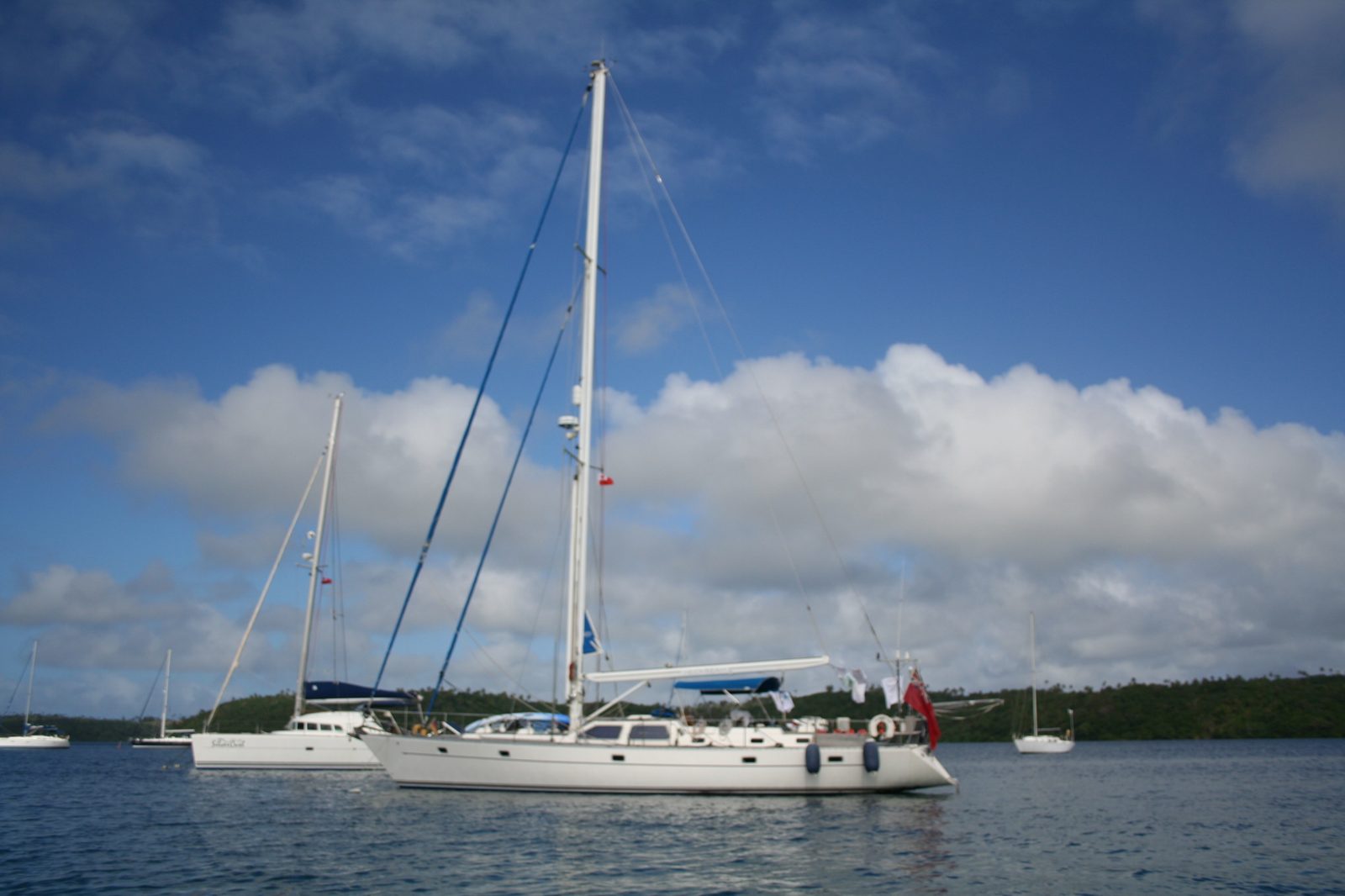
Our time in Tonga was coming to an end so we bunkered some fuel, topped up our supplies and checked out. We passed the lovely beach at anchorage #8 (Mooring’s guide) where the Navy had been preparing for the King’s BBQ. Tents and furniture had been laid out and it looked very grand indeed. However, we hadn’t been invited so we decided to continue to Fiji. Our sail was uneventful, mainly under the Yankee alone with the wind abaft. Sarah resorted to English Channel gear with about five layers topped with thermal trousers and oilies because it was overcast with rain and drizzle and cold – well relatively.
There was one bright spot: Moonbeam has now completed half her circumnavigation. We have covered 18,000 odd miles in the process. When you say it like that it seems an awful lot of sailing.
Now herein lies a lesson. We picked up the loom of the lights of Suva a couple of hours out. Given that the sailing directions and chart indicated that the leading lights through the reef were red and easy to see, we decided to go against our rule of awaiting daylight for the reef passage. However, when I lined up the red lights, our approach was adrift of the leading line on our plotter. Thankfully, our disquiet at this anomaly prompted us to abandon our approach. This was extremely fortunate because had we followed the red ‘leading lights’ we would have impaled ourselves on the reef. Having aborted our approach, we followed an inbound container ship and subsequently were able to confirm with Port Control that the leading lights had been changed to blue! In fact, the Pilot boat, who had obviously overheard our conversation with Port Control, stayed on standby until we were safely through the reef.
On reflection, having abandoned our first line of defence – transit by day – we had been rescued by our agreement that either of us could veto a plan if we were not entirely happy. This saved the Insurers a lot of money and very possibly saved us our lives.
Suva, Levuka and the Yasawas
We were directed to the Quarantine Anchorage and dropped anchor for a lovely sleep. The problem of arriving here on Saturday was that we were forbidden to leave the boat until processed by the Authorities and that is not going to happen until Monday! Happily, Brian from ’Scraatch’ was nearby and he delivered us a case of beer and an internet card, so we were able to communicate with the outside world.
On Monday at about 1100 hours, Quarantine and Health pitched up in a harbour launch. They went around the boats in order of arrival over the weekend and dropped off a ream of forms to be filled out. Then, when they returned about 20 minutes later, they collected these forms and filled out a few of their own, asked what provisioning we had on board, and then told us we could take down our ‘Q’ flag and go ashore. We duly took the dinghy into the Royal Suva Yacht Club where, once again, we met helpful and friendly staff. However, our mission was Immigration and Customs which were located inside the main commercial port. More lengthy form filling and then back to another government office to obtain our cruising permit. Back to Suva the following day (happily taxis are cheap here) to pay the Port Captain and we had officially entered Fiji. Sadly, this was not the case as we found out that we had effectively only arrived in the port of Suva, and we had to repeat this process of checking in and out of each of Fiji’s ports. What the Fijians did with all this useless paperwork is anybody’s guess. But we made the most of our visits into Suva, wandering around the thriving market and visiting the fascinating museum. There was an interesting display of old traditional outrigger canoes, weapons, cannibal forks and the history of tattooing. We walked around the Thurston Gardens which was the original site of Suva village and had lunch at the busy bowling club overlooking the harbour.
We decided to sail around to Levuka which was the original capital before colonisation. So, having checked out of Suva, we set off for a pleasant sail. We discovered why the capital had moved when we arrived in the harbour, which was exposed to the Trade Winds, with the rather run-down town, abutting steep hills behind with no room for expansion. Added to this, the aromas emanating from the fish factory on the wharf made the anchorage rather unsavoury. Happily, when we went ashore the following day, we were able to check in and out at the same time. Levuka had obviously seen better days, and although the (only) front street looked like a set for a Western movie, everything needed a fresh coat of paint. We returned to the boat and after a roly-poly night set off once more to return to Suva. Our arrival back on Saturday meant that we could not check back in until Monday, by which time we had decided to go to the Yasawa Group of islands. For this, we needed to arm ourselves with some kava. A set of twigs held together by string and looking like (and called) a witch’s hat set us back about $15. This was sold in the ‘grog’ area on the first floor of the market.
We met Amanda and John off ‘Gingi’ and Jim and Diane off ‘Prarie Oyster’ on a mission to get their visas for Australia, their intended destination. Amanda is English although her home was San Francisco for many years before taking off cruising with John, a jazz musician, some 15 years ago. We had first heard John practising his trumpet scales back in the Tuamotus, but he had entertained us royally in the ‘Bounty Bar’ in Tonga with keyboard and trumpet. He had been offered a job teaching music back in the States, so their plan was to sell the boat when they reached Australia.
The following day saw us dropping anchor in Momi bay, by Nadi (pronounced Nandi), and then we moved into Vudu point marina, which is an unusual circular construction with boats moored fore and aft against the wall. We had wifi access here and we were able to catch up on a few chores and the laundry. A taxi ride into Latuka, which had the feel of a country town with a magnificent market, allowed us to check in with customs. There is a huge sugar factory here and enormous loads of sugar cane were being transported by trucks and a railway which ran around the plantations. We had come into town with the lone skipper of ‘Isis’ a 25ft sloop, who was a young fisherman on Salt Lake, Utah for two months of the year. In this period, he made enough money to fund his cruising for the remaining ten. He fished for food that was given to prawns in prawn farms!
Our visit next day to Nadi was disappointing. The romance of the name contrasted starkly with the reality of the town. We had no wish to stay and certainly would not holiday here. No sooner had we put our nose out en-route to Waya Island in the Yasawa Group, we had to reef right down when the wind picked up. The brisk sail was uneventful until I shouted “hang on” at the top of my voice, because two whales broached right in front of the bow, so close that I thought we were going to hit them – we could certainly smell them, but fortunately we missed. We spent a couple of lazy days making repairs to the bimini, which is really on its last legs and went ashore to present our kava to the Chief of the village, in accordance with the custom we had read about, in the cruising guide. The extent of the poverty was quite sobering in contrast to what we had seen elsewhere, and we wished that we had brought much more ashore to give to them. We were taken to the Chief and sat with him cross-legged on the floor of the Meeting Hut along with his right-hand man, whilst the Chief enquired of us, in very good English, about our voyage. Then, together they launched into a greeting in Fijian, where we recognised that he was blessing our voyage and afterwards he extended to us the freedom to wander in and around the village and to stay in the bay.
However, our visit was cut short by me tripping on the foredeck and breaking a tooth on the open hatch. The tooth, which I thought was my implant, went through my lip, and I clearly need some medical attention. We were in two minds as to whether or not it needed a suture, so we returned to the marina and went into town to locate a doctor. I did not plan to seek out a dentist until we reached New Zealand! A couple of days later (Friday) we decided to depart and therefore we needed to check out. What a drama that proved to be! Customs asked where the boat was and stated that we couldn’t be processed because we hadn’t brought the boat around to the anchorage where they could see it. Additionally, Immigration chipped in that the law stated that once we had cleared out, we had to leave immediately without further stepping foot on Fiji soil. This impasse was clearly not going to be resolved by me losing my temper, which I have to say was my first reaction. So, I grovelled. I pointed out the injury to my face which had now taken on a colourful bruising under my tan and otherwise generally ate humble pie. This was all done in the room where a somewhat faded picture of a young Queen Elizabeth still hung on the wall. After about 45 minutes of this the big Chief of Customs grudgingly signed the forms and then handed them to Immigration. Whilst all this was going on, I had to listen to a series of lectures about how I had transgressed their laws and that if they gave in to me then, they would have to give in to others. I was admonished to return directly to the boat and to depart immediately.
Well, this was all well and good, but we needed to go to the supermarket to stock up on our provisions for the journey. Given that this was Friday afternoon, we had this vision that Customs and Immigration would decide to go home early and trip over us in the town and throw us in jail. However, they didn’t, and we arrived back at the marina fully provisioned and ready to set off the following day, for what we anticipated would be an 8 – 10 day passage.
Passage to New Zealand
Now, it would be true to say that Sarah had been getting steadily more apprehensive about this final 1300nms leg to New Zealand. It did not help that over the past few weeks we had listened to various ‘war stories’ about the passage, and that in Jimmy Connor’s book of World Routes, he makes the statement that it could be ‘difficult’. As ever, the longer you dwell on these things, the worse they appear. So, the best thing to do was to get on with it.
It was to be a passage of contrasts. The water temperature when we left was 26.5C and when we arrived, 17.4C. We started out with a lovely sail through the lagoon and then the wind left us and became light but mainly from the south, requiring us to sail close-hauled. Added to this we were in a trough of low pressure and the incessant rain showers made it wet and miserable. By day 4, Sarah threatened to get off, but given that we were 500nms from the nearest land, I didn’t take it too seriously. However, there was an underlying message here as I had undertaken not to sail with the wind forward of the beam and only when it was warm. In that we were beating into a wind that came directly from the Antarctic and we were wrapped up in oilies and only made 44.9nms in the last 24-hour period, I was not doing so well.
It took a week to get just over halfway and because we knew that Quarantine would take all our fresh food, we had not over catered, with the result that we were running low. We had landed a fine yellow fin tuna, it is true, but the fresh vegetables were at an end. The Iridium satphone playing up in its usual fashion had one positive outcome, which was to force me to make the weather fax work using the SSB radio. This meant that although weather from the satellite was intermittent at best, I was able to download synoptic charts and forecasts for +24, +36, +48 and +72hours. However, the main GPS that drives the plotter started announcing that it had “no fix” and after a couple of days I traced the problem to the antenna cable, which I must have disturbed when I was playing with the SSB.
These minor irritations were as nothing when the rudder jammed on full lock. I think that this was the first time I had ever felt insecure on Moonbeam. We were close-hauled with the wind in the south, force 4 and the autopilot had driven the rudder to full lock where it had jammed. Well, we hove-to as best we could and when I had calmed down and started to think through the problem in a logical way, I recalled our conversation of a few days ago. This concerned the change in the ‘whirring’ note of the autopilot that is ever present in our cabin. Essentially, when the autopilot is engaged the electric motors run backwards and forward to adjust the position of the rudder to maintain course. This is presented as a ’whirring’ noise that is only noticeable for a short period before the brain shuts it out: that is unless the noise changes, which it had done. With this in mind I got everything out of the lazarette so that I could get at the rudder quadrant and traced the problem to the left hand drive unit, which I withdrew and subsequently replaced with the spare – what a relief!
We had started out from Fiji with about 500ltrs of fuel which I had thought was more than enough, but in addition to running the generator for battery charging and refrigeration we had been motoring to try to push ourselves on. Consequently, I was beginning to get concerned about our fuel state, so I decided to top up our main tank using the deck supply of 45ltrs which were nominated as our whale deterrent. Sarah had read that if a whale gets too close to the boat, a few gallons of diesel in the water will do the trick and persuade it to go elsewhere. But, by now our only escorts were dozens of storm petrels and an occasional albatross.
Landfall at Whangarei, September 2008
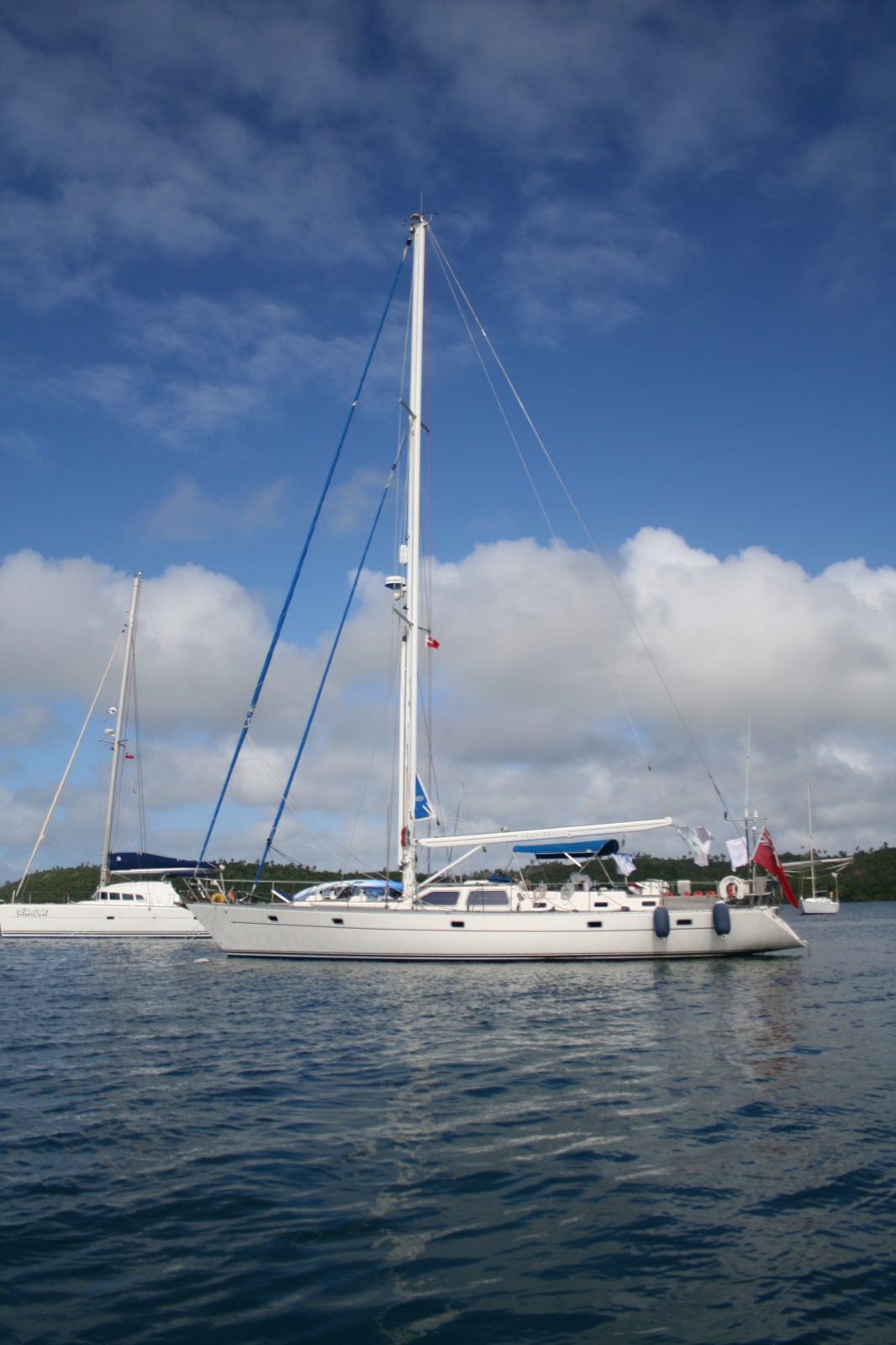
Then – joy of joy, eleven days out, “land ahoy” – we could see our destination. Oh, what a feeling! Another 60nms and we hove-to off Bream Head awaiting sun-up and, at 0945, 15minutes short of twelve days, we tied up on the customs wharf at Marsden point for a genuinely warm welcome by Customs and Quarantine for clearance into New Zealand. Once cleared, (we were the first foreign arrival of the season) we went the 15nms up the river and moored at Whangerei Town Basin Marina to start our New Zealand adventure, which is another story. It was 25th September 2008, 10 days short of 3 calendar years since we left England, with 19442nms in the log – what an achievement!
I don’t have words to describe our feeling of absolute euphoria. For years, I had declared my dream that, when I retired, I would sail to New Zealand: and here we are. In truth, it has been easy for me. I have navigated all my life, instructed pilots for over a quarter of a century, commanded a crew for over half my career and held positions of high responsibility in a big organisation. I am practical and I can fix things. So, the real achievement is not so much mine, but Sarah’s. It was my dream to do this, not hers. I think that if you asked her what she wanted to do with her life after I retired, and she gave you an honest reply, going sailing would not come very high up the list. She has felt badly torn between this adventure and being home to support Annabel in her preparations for her wedding in November, and being there for Gemma, during her pregnancy and the birth of our grand-daughter, Eloise. We have, of course, been fortunate to be able to travel home and even more fortunate that friends and family have visited us along the way. That said, there are not many women who would want to spend very much time alone with me in a yacht, let alone 3 years! I fell in love with, and married, a very special lady.