Port Louis, Mauritius, May 2011
Having been on standby initially, Sarah had a seat in club, but was alarmed when she heard the announcement for immigration forms into Mauritius because there was a need to prove that she had a return ticket, which of course she didn't. It took one and a half hours for immigration to confirm that Moonbeam was in fact in the marina and that she was a member of the crew, whilst I was waiting to welcome her.
However, this was all quickly forgotten when she found out that I had booked us in for three nights at Le Paradis. We had a lovely stay here before returning to the boat via a Bricolage to buy a plug to connect with shore power, and to find Batu with a plaster cast all the way up his leg. This meant that clearly it was sensible for Batu to return home to Galle, but in talking to some cabin crew in the hotel, John found out that it would not be possible for him to travel with the plaster that he had, unless special arrangements had been made beforehand. Consequently, he borrowed my Dremel and cut off the top of the plaster and made a slit down either side so that Batu could depart on Emirates via Dubai to Sri Lanka.
We started exploring the island in the way that had not been possible when visiting on a trip whilst I was flying, and discovered good supermarkets, and many useful outlets including a diesel service centre, where I took the fuel pump for repair. When we returned to the boat, we found that John's wife, Julia had flown in that morning, and they had decamped to the Suffren Hotel across the water. He had joined Paco in Perth five months previously, and they had not seen each other since. They all came to dinner on Moonbeam, and it was clear that Julia was not prepared to allow John, who had shaved off his beard, to continue even though he wanted to. Her declaration was along the lines that if he wanted his conjugal rights, he had better come home.
The arrival in Mauritius raised a problem for Paco, in that immigration clearly did not like Sri Lankans. It was necessary for Paco to guarantee that they would depart Mauritius in due course, and to regularly take them and their passports to the immigration office in Port Louis. This meant, among other things, that because he was returning to Australia for a visit, it was necessary to appoint a captain for ‘Nautibuoytoo’ who would take on this responsibility. It was not allowed for me to be in command of more than one boat, so Sarah was promoted to captain of a 65-foot catamaran as her first command!
The hill behind us was called Signal Hill, which was part of Long Mountain. It had radio masts and a magnificent view from the top. It was an 11 km round trip up a road which was quite steep in places, and which we started to climb on a regular basis. We left early in the morning in order to get back before it got too hot and then recovered with some breakfast. It was obviously a favourite venue for exercise for the locals, and in parts of the climb we would meet local Chinese walking up it backwards!
Towards the end of May we had a final lunch with John, Julia, and Paco at the Suffren Hotel, before they left for Perth. John would not return, and Paco would be away until 20th June. It was sad to say goodbye to John because he was a lovely gentleman and had become a good friend.
We had become aware that a Danish yacht (ING) had been taken by pirates, and as usual a ransom had been demanded. There had been a request in the yachting community for contributions to raise funds for their release. With that in mind, and still angry at the incompetence of the organisers of the Blue Water Rally, I wrote to ask that our payment for the transit of the Suez Canal be donated to this fund. However, I got no reply and I doubt that they did so. When the ransom was finally paid and the family escaped, both the mother and daughter were pregnant.
We kept a close eye on Kason and employed him to clean the stainless at US$10 an hour, a rate that had been agreed with Paco. We generally looked after him and regularly fed him but each week we insisted that he cooked for us. On the first occasion as with any young man, he rang his mum to ask what to do, and provided us with a delightful Sri Lankan meal.
This was a great place for a yachtsman to be because I found somewhere to re-galvanise the anchor and chain, any number of tools that I needed or might need and a radio specialist who was able to test my HF when I took it all out of the boat so that he could put it on his test equipment. I did this because it was clear whilst we were in the Blue Water Rally that our HF signal was weak. Having thoroughly tested it and found no faults, he sold me a length of 6 mm wire to reconnect the antenna tuner to the backstay, and lo and behold once more I could emit a hundred watts. I found a Bricolage where I could buy stainless steel pumps with which I could replace the refrigeration and air-conditioning pumps that I had bought in New Zealand, and which had since failed.
We got to know Jill and Tony off ‘RealTime 2’ which was a 55-foot catamaran. He had been a master mariner. They had been en route to the red Sea when Quest had been taken and promptly reversed course and turned up in Mauritius. They were from Anglesey in North Wales but lived in Northern Cyprus and told us that they had been wiped out financially by a Ponzi scheme, which Tony admitted he had got involved in by greed and the promise of 20% interest rates!
Tony accompanied us up Signal Hill and I learned that he was looking forward to receiving his full state pension. Knowing that he had spent long periods abroad, and having had experience of dealing with Sarah's pension, I asked him whether or not he had paid national insurance throughout the time that he had been working. It turned out that he hadn't. As he was approaching retirement age, I explained that he had a small window to top up his national insurance contributions in order that he would be able to receive the maximum state pension. I explained what we had had to do for Sarah, given the initial indication that her pension would be £20 per week and all that we had to do to correct the position, so that she would receive the full pension to which she was entitled. I tried to make clear to him that if he didn't sort out the position, then once that window was closed, he would be unable to change whatever HMRC were going to pay him. I do hope he took this advice but somehow think that he probably didn't.
Across the water by complimentary ferry, the Suffren hotel held a happy hour each Friday where the young and beautiful of Mauritius all turned up for music and entertainment, and where the Moonbeam crew went to enjoy the spectacle on several occasions.
We were asked to move up a little into the marina to make space for a discovery 65. Stuart and Patricia from ‘Rhianna’ joined us for a drive up to Grand Baie and on to the Sea Lovers Restaurant where we got to know this very pleasant couple. They were childhood sweethearts that had been extremely successful establishing ‘Gael Force’ marine equipment suppliers in Inverness. This had developed form his apprenticeship as a welder, when he saw the opportunity of making indestructible lobster pots. In addition, he had bought much of the Inverness waterfront and was developing it. Stuart was a very lucky man because he needed to wear a brace or girdle because he had gone motorcycle scrambling in Langkawi and whilst doing a wheelie, had come off and broken his back. He was carried out of the Forest where this happened and transported to Penang, where to his good fortune a surgeon was able to repair his spine and here, he was in Mauritius shortly afterwards!
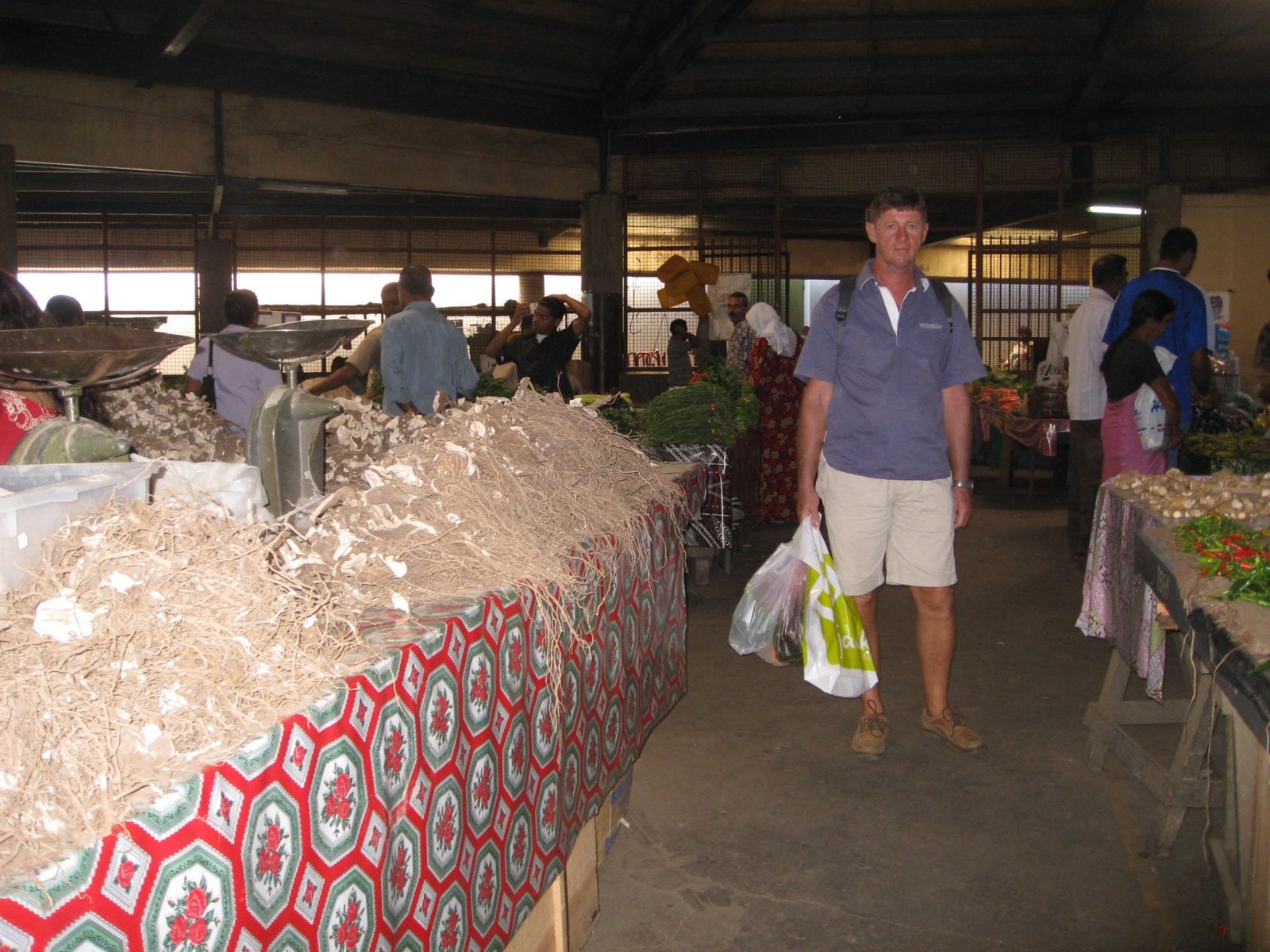
The market in Port Louis was a large building selling all manner of fish, vegetables, and meat along with most other things. Venison had just come into season and was clearly plentiful at this time of year and we were able to buy loin fillet steaks extremely cheaply.
We stayed in the marina until Paco returned from Australia on 20th June, and Sarah was relieved of her command and released from and the responsibility for Kasun. During this time, we walked up Signal Hill regularly and became enchanted with this lovely island. The combination of French English and Indian backgrounds ensured that the local Mauritians were delightful. It helped that everyone spoke English, but the cuisine was such a mixture of French, Creole and Indian, that anywhere we stopped to eat we were very well fed.
We entertained Peter and his crew from a ‘Amber’ which was a UNESCO boat that spends its time dropping buoys every 350 miles, where they would sink to 2000 metres over a period of 5 to 15 days, collecting data so that when they resurfaced it was transmitted via satellite to researchers examining the effects of global warming on the currents, sea temperatures and many other parameters. One of the fascinating things is that although they were dropped 350 miles apart, when he returned to pick them up, a few months later they had tended to congregate into a relatively small area of the ocean.
Grand Baie, July 2011
Tom arrived for a two-week break just before Sarah's birthday so we decided that we would have a night stop in Le Paradis. The hotel had obviously kept track of our previous visit and completely unexpectedly produced a birthday cake on a square platter that we still have in Moonbeam. It was a lovely gesture. We met Bill and Gene off their catamaran ‘Out of the Bag’ once we had gone up to Grand Baie to anchor. We were made temporary members of the yacht club, and later they would present their visitors book for us to complete with a map of our circumnavigation so far. I spent a considerable time under the boat in fact nine dives in all, to clean the marine weed and barnacles that had grown on her hull. We had the dive tank refilled at the local dive centre called Seaman Diving! It was also an opportunity to renew the anodes and separately to polish the hull above the water line. At last, she looked presentable once more.
There were many tasks undertaken during this lovely spell, including renewing the bow thruster batteries and obtaining and fitting new relays for it, varnishing the cockpit and saloon table, repairing the spray hood along with the myriad of other things.
The Botanical Gardens at Pamplemousses were quite staggering, with the giant water lilies with leaves like giant plates and producing a lovely white flower which turns pink the following day and then dies. A visit here would not be complete without viewing the giant tortoises.
We completed some administration tasks with a little perseverance. I needed a visa for Madagascar, and Moonbeam needed a new registration certificate from the UK. This finally arrived at the British Airways office in Port Louis, and the visa was obtained from the Madagascan Embassy over a period of two days. However, a delivery for Sarah's computer arrived in customs, and was as difficult to extricate as it was in Sri Lanka. I was threatened with the need to engage in agent who would charge ₹6000 for something costing peanuts.
I wasn't prepared to accept this and turned up at the Agents and insisted that I paid them the customs duty and ₹1000 for their assistance. I don't think this had ever happened to them before! On the plus side, a Coast Guard cutter appeared alongside us to advise that a package had been received at the Le Caudan marina!
Whilst Tom had been with us, we looked at a number of model ships so that we could buy one for his birthday. Model ship building was an important business in Mauritius and many of the models were just beautifully made. Tom chose a model of the Endeavour which we acquired after he left, and I would need to take home from South Africa. On 26th July we left Grand Baie a little apprehensively as the entrance was very shallow and returned to Port Louis. We moored in front of ‘Katrinya’. This was owned by Bruce and Gina, who were travelling with their daughter Rachael. They were from New Zealand where Bruce had been a close protection policeman. We were invited for a meal along with Julia and Jim from ‘Papillion’ as well as Paco and Kasun. It was a really fun evening with Sarah and I doing the starter, Bruce and Gina, a venison casserole, and Julia a pumpkin pie.
Our plan was in accordance with everyone else to make the next destination Ile Reunion. It appeared that the main port of entry was Le Port in the northwest corner of the island, but before we left Sarah bumped into Bill and Gene off ‘Out of the Bag’ who had decided to make St Pierre their land fall because it had a small marina on the west coast, albeit with a challenging and shallow entrance. When we looked at it this it seemed to be a good place to aim for, where there were facilities to check-in. This would be a much nicer place than going to the main industrial port.
I serviced the generator, the water maker, and the engine in the last few days in Port Louis before we were ready to move to the Customs wharf by 1000 on 31st July to clear out of Mauritius. This took less than an hour and we said our goodbyes to Paco, Gina and Bruce who were on the key and set off for Ile Reunion, 160 miles away.
St Pierre, Réunion, August 2011
We arrived at St Pierre by 0830 to be welcomed by Gene and Bill who had got in the day before, and Gilbert who was the port captain. He was a little worried about whether or not there was enough water in the entrance but the least depth we saw was 2.9 meters, and that was at low water. However, this said, we arrived when there was very little wind and almost no swell. We docked to find that it was a lovely port and we felt that we could be back in France. The marina was full of small French leisure fishing boats that you see all around the French coastline, but we were in the middle of the Indian Ocean! We moved out over to our allocated pontoon which was in the deepest part of the marina and awaited the arrival of immigration that, being a Department of France didn't bother to turn up. So, we went up into the town to explore, and once again it reminded us of Cannes with narrow ending streets with even the same shops!
Bill and Gene came to supper, and we arranged to hire a car and drive up to see Cilaos through the most amazing countryside. It was very mountainous with steep straight sided gorges which were incredibly beautiful and totally unexpected. There were lots of narrow hairpin bends and sometimes single lane track roads and single-track tunnels to reach this mountain village of 6000 people.
The next day was really a day to remember. We made an early start to visit the volcano Piton de la Fournaise and had an absolutely fascinating but exhausting walk up to the crater over volcanic rocks, some looking like melted wax which reminded us a little of Lanzarote. We had to climb up 500 steps, at the end but it was not as tortuous as we were expecting. The round trip took five hours there and back even though we were not slow. We clearly should have started earlier because when we arrived the car park was full, but when we got back it was almost empty. Sarah had taken her walking poles with her, for which Gene was thankful for one and Bill the other!
We had been warned of a swell, known locally as la houle which was to coincide with an exceptional high tide at 1600. When we got back, we found the access to the marina blocked and there was debris all along the road outside and inside the marina. It was extraordinarily quiet principally because all occupants of the boats that were tied to the pontoons had been evacuated to a local school. This was because the marina personnel were worried the pontoons would come apart in the surge. I went down to secure Moonbeam with more lines and Sarah tried to find a hotel for the night, but they were all full. We decided the safest thing to do was to sleep in the car for four hours over the next high tide and in the end were able to return to Moonbeam to find happily, all was well.
The gale continued to blow for two days, and the huge surf across the entrance to the marina was dramatic. Certainly, no one would contemplate entering the harbour in these seas. Nevertheless, out of the wind, the air temperature was quite warm.
The first Saturday we were there we walked up with Bill and Gene to the Saturday market which was great fun. It was very busy because there were lots of stalls selling vegetables, flowers, cheese, meat, pies, and crafts. Also, on sale were live chickens, ducks, and rabbits. We could have been in any thriving market in France and would do this repeatedly every Saturday that we stayed in Ile Reunion.
A trip up the mast revealed a separated strand on the staysail stay, so I tracked down a chandlery who was able to supply a replacement. I took the staysail foil down and rethreaded the new wire and connected it with spares that fortunately I had on board.
We watched ‘Vamp’ arrive from Mauritius. They had a really entertaining time in the entrance because the wind and swell were quite strong, and in trying to turn in the marina lost control but happily did not damage themselves or the catamaran that they touched.
We hired a car again and took the road across the island to St Benoit and then up to Salazie and Hellbourh up an amazing gorge with spectacular waterfalls. We returned by driving around the north of the island, through St Gilles and St Denis and stopped at the tiny marina there where there was certainly no room for Moonbeam. Returning along the coast road we saw a pod of whales just offshore.
We entertained Bill and Gene and Carmen and Kim off ‘Vamp’ that evening and had dinner on ‘Out of the Bag’ a couple of days later with them all. We all brought and shared dishes once again. Carmen and Kim brought their daughter Rachel with them, who was a vegetarian, so each of us made a suitable dish for her too.
We were amused by Kim and Carmen's description of their climb up the volcano. They came back with their walking shoes having fallen apart. Carmen’s were held together with a hairband and handkerchiefs and Kim had given up before his completely disintegrated! I was vindicated in buying some walking boots prior to us going up, because I was concerned that I might have had a similar problem given that I hadn't used them for many months.
In about the middle of the month both ‘Out of the Bag’ and then ‘Vamp’ left for Madagascar, and Paco arrived from Mauritius. We decided to head up to Cilaos having talked to a local Frenchman on the pontoon, who advised that we definitely should not miss Mafate, which was a remote volcanic caldera. When we arrived, we saw that the sign for the walk up to the Col de Taibit was a five-hour 8 km trek there and back with an 800metre rise and was described as medium/difficult. It was more difficult than medium, but the view from the top was well worth it.
Towards the end of the month, we started thinking about how to get Sarah home so that she could be with Annabel towards the end of her pregnancy. The obvious way was to take a flight to Mauritius to pick up a BA flight home to London on 5th September, assuming as always that space was available. We booked a flight on Air Mauritius, a return for me and a single for Sarah on the day before, and night stopped in the hotel adjacent to the airport where I used to spend the day when flying a shuttle from the Seychelles.
It was a sad farewell as I returned to Reunion because I was not looking forward to being on my own again until returning home, hopefully from South Africa, after the birth of Annabel's baby.
The end of the month saw another ‘la houle’, accompanied by a severe gale for several days during which the port was closed. A month spent here in Ile Reunion left us with a lasting impression of the beauty of this remote island with its rugged mountainous countryside and delightful French inhabitants. It is definitely on our list of places to revisit.
Preparing for South Africa, September 2011
The next few days were spent preparing for my departure for Richards Bay in South Africa.
It would be true to say that most yachts were reported to track north of Madagascar and then south-westwards along the west coast, before setting course for Richards Bay or Durban. The challenge was the Agulhas current which runs southwards along the East Coast of Africa. It is a narrow and strong. There were a number of strategies to minimise the risks of meeting mountainous waves that were built up by a southerly gale meeting this current. One well tried plan was to sail south of Madagascar for about 600 miles before turning due west to shorten the exposure to this current prior to reaching the continental shelf where any big seas started to diminish.
Now, I was well aware of the potential that by reading too much into the sailing directions and advice on Noonsite, it might undermine my confidence in tackling this part of the journey. Nevertheless, we had had an email from Stuart on ‘Rhianna Marie’ who had decided to route direct to Durban. He and his son described the most terrifying story of struggling to get through the current when a southerly gale set in. The bottom line was that he was very grateful to still be alive.
With all that in mind, Paco, together with Jim and Julia off ‘Papillon’ who were going to sail with us, decided to route to the south of Madagascar towards Toliara Harbour, and if necessary, wait there for a weather window before proceeding direct to Richards Bay.
With a good forecast for the next three days, we all departed on 14th September, me a few hours later than the other two because there wasn't a great deal of water in the entrance, and waved goodbye to Ile Reunion, for the last time.
An uneventful two days saw Moonbeam crossing the Tropic of Capricorn and then entering into a period that I described in the log as ‘Piccadilly Circus’ with ships like fireflies around me. This of course was around about midnight so there wasn't much sleep to be had that night. Steady progress was made until a south-westerly gale picked up and I hove-to with a serious rip in the mainsail and decided that I needed to divert to Fort Dauphin in Taolagnaro for repairs, and advised ‘Nautibuoytoo’ and ‘Papillon’ accordingly, whereupon they altered course.
Fort Dauphin, Madagascar
My arrival in Madagascar left something to be desired. I contacted port control when I closed the land a bit before sunset, only to be told that I was headed to the old port. They had built a new one which was not on the chart plotter, or my paper chart. The new port had been built and was run by Rio Tinto, for their mining operations. Paco gave me a couple of waypoints and then the port captain talked me in so that the arrival was in the right place and safe enough.
Of course, by this time the wind had picked up from the North and it was too rough to get the boat ready for docking, so I had to do everything at the last minute, which is something I don't like to do. However, this being a big commercial port there were line handlers on the wharf, and as I was coming alongside nicely, I got the aft line to them but needed to go back to the cockpit put some power on to go forward, when the engine failed! I thought that it would be helpful to alert the line handlers to the fact that I had this problem and shouted “engine failure” whereupon they promptly cast me adrift, and the dinghy was punctured by a stanchion on the wharf.
So now Moonbeam was waltzing across the harbour towards the breakwater with no power and no means of steering her. Luckily, as usual, I had my Leatherman on, so I ran forward and cut the anchor tie and managed to get the anchor down in time to stop hitting the rocks. A quick inspection of the starter motor showed it to be completely stuck, which meant that it was not going to be a quick exercise to get the engine going. Meanwhile the Port pilot who was clearly very English came on air to say that he would try to get their Zodiac in the water but failing that he would organise a tug crew. They had two massive tugs tied up, and the thought of being charged by the Port authority for their use filled me with foreboding. By this time Paco had arrived in his dinghy and we agreed that if we could get a line across to the wharf where five line-handlers were waiting, they could probably pull me across. We were never short of rope on Moonbeam, so we tied some together and Paco took one end to the wharf where the line handlers pulled me across and finally Moonbeam was tied up. This was to be the closest that I ever got to putting Moonbeam on the rocks and this was in a harbour!
Being the first yachts to visit the new Rio Tinto port of E’lohara, brought its own challenges. We had an uphill battle with the port captain over the charges that he planned to levy. This was because the only visitors before us were commercial shipping. Eventually, we managed to persuade him that a reasonable charge would benefit the port, because we would be able to advertise the welcome that was offered to visiting yachts on Noonsite to indicate that this would be a good destination for yachts en route from Ile Reunion to Richards Bay. This in turn would be good for the inhabitants of Fort Dauphin.
That battle being won did not help us with respect to the local port captain who demanded to see evidence of crew competence. Neither Jim nor Paco had anything, but luckily my International Certificate of Competence issued by the RYA, which was copied 3 times, was reluctantly accepted as evidence for all three of us. In addition, he was extremely reluctant to issue us with a port clearance for departure without payment of a substantial sum in US dollars. We finally extricated ourselves through a little bit of bribery, threats, and a lot of corruption. It would prove to be the only exit clearance we would receive from Madagascar, and which would be needed for entry into South Africa.
Fort Dauphin in Taolagnaro was extraordinarily poor. The locals lived mainly on rice and fish, the forests were denuded for charcoal and the fishing was undertaken in the most primitive of canoes. However, unlike Sri Lanka or India there was no begging and so it was a real delight to be able to donate clothing colouring books colouring pencils and lipsticks that Sarah had put together for just such an occasion. The smallest gift was met with the biggest smiles.
During the time we were at anchor here, I rebuilt the starter motor, which is a complicated piece of kit on a Perkins Sabre 92, no less than five times. This was because every time I put it back together it failed. Eventually I traced the problem to a crack in one of the electrodes once found was able to solder it so that I was able to start the engine once again.
I completed repairs on the yankee and staysail with extensive use of the sewing machine, but the damage on the main, would clearly need to be repaired in a sail loft. I fabricated a temporary repair as best I could with sail repair tape hoping that it might hold until reaching South Africa. The tear in the dinghy was nearly 30 cm long and was beyond repair with the spares any of us had on board and would also have to wait.
Fort Dauphin to Toliara, October 2011
After 10 days we were ready to depart Fort Dauphin for the 300-mile trip to Toliara. To help matters a weather net was set up on HF SSB. The net was run by a group of yachties who examined the forecasts and satellite images to provide individual advice to yachtsmen inbound to South Africa. It was known as the Perri Perri net. Once you checked in with them with your position and destination, they would provide the best assessment of the weather to be expected in the immediate area around your position. We all joined the net here to add to the grib forecasts and anything else we could obtain.
The trip was straight forward, with generally light winds and little swell. From time-to-time Moonbeam was surrounded by whales – a really stunning sight provided they didn’t get too close!
The arrival in Toliara revealed a completely different climate to Fort Dauphin just 300 miles to the East. It was considerably wetter here contrasting against the arid landscape in the East. It was necessary to go ashore for clearance, not least because the only boat that customs and immigration had was a rib that was on the hard minus its engine. However, the entry procedure was relatively straight forward and surprisingly free of charge. The town was a short walk away and bustled with roadside stalls where it was possible to buy almost anything. There was a small supermarket that was reasonably well stocked, and the town also supported a wine shop, which enabled Jim and Julia to spend a couple of hours discussing which wine they would buy for an evening meal on Moonbeam. This was notwithstanding that most of the bottles on the shelves had been standing there for the best part of several years!
It was here that Paco had his dinghy stolen. He had not lifted it and during the night it disappeared. Now we had every suspicion that its whereabouts was well known by the locals living here and who we engaged to drive us around searching for it. This was, needless to say unsuccessful, and so it was necessary to report the theft to the police, so Paco could claim for its loss on his insurance. This was duly done at the port police station and at the completion of filling in all the paperwork, the policeman demanded US$20 for his trouble. Paco was not unreasonably unwilling to part with this on the basis that the policeman was doing his job. He followed us around town for the next few days, which made Paco even more obstinate. However, this was to prove to become somewhat of a problem when we wanted to depart. This was because he alerted the Customs and Immigration officers to the fact there was an outstanding unpaid bill. This meant that they were unable to issue us with a departure clearance. This put us between a rock and a hard place, and so we decided that given the weather was about to change, (and that we had a clearance from Fort Dauphin), it was not unreasonable for us to move down the coast temporarily for protection, which is what we told the port authority. We did this on the evening of 8th October and anchored in the Baie St Augustin about 10 miles east. We knew that there was no chance of being chased by customs or immigration because their boat was still engine-less on the hard, and with that in mind, we departed for Richards Bay early next morning to cross the Mozambique Channel.
Mozambique Channel to Richards Bay
After all the concern about the dangers of crossing the Mozambique Channel the five days that it took to sail 720 miles proved to be uneventful. We had left in a good weather window and as a result the wind and seas were quite benign. So, after the usual minor challenges, Africa appeared on the radar along with its characteristic smell. I didn’t get much sleep as there were dozens of ships outside Richards Bay at anchor awaiting a berth to load or unload their cargos, but in the last few miles a pod of whales appeared port and starboard - what a wonderful welcome to South Africa! I moored alongside ‘Nautibuoytoo’ inside the small yacht basin in order to clear customs and immigration but this being South Africa neither turned up to the boat. As a result, we took a taxi to find them downtown and cleared in successfully. This done, a couple of days later, we sailed ‘Nautibuoytoo’ around to the Zululand Yacht Club and I returned on foot with Kasun to bring Moonbeam around and where she would rest for the best part of two months.
It is impossible to overstate the hospitality of the Zululand Yacht Club and it is members. We were all welcomed and were known during our stay as the ‘Internationals’. There were a few live-aboard locals and a number who were working on their boats on the hard. I was originally thinking that I could pull Moonbeam out for a clean and replenishing the antifouling, but one look at the tractor and trailer used to pull boats out and the props available to prop them up, soon changed my mind. It would have to wait until Cape Town.
As soon as we arrived, and after a fun evening on Moonbeam, we were taken in hand by a family who were building a catamaran in order to sail around the world. They were living inside and underneath the hulls that were at the stage of being fitted out. The family, husband, and wife and their three teenage children, a boy and two girls, were all involved. We were shown the downtown area and introduced to the available supermarkets and the areas where anything could be fabricated for a boat. The girls were employed on Moonbeam to give her a thoroughly good spring clean, and they did a really good job.
I hired a car with a view to stay mobile, but also to be able to leave it in Durban because I planned to return home to be around when Annabel's baby was born.
Because of the influx of international yachts, representatives of both North Sails and Quantum Sails, turned up in order to arrange repairs and refurbishment, and in my case to build a new mainsail. North Sails offered me what I thought to be a very compressive price, but when I challenged Quantum, they undercut it and so got the business. Both sail lofts were based in Durban and so I arranged for Quantum to build the mainsail for delivery in Durban, but to refurbish the yankee and staysail for collection when I returned from London.
Monday was known as Braai Night at the Club, where the barbecues were lit, and everybody brought their own food and wine and cooked their steaks or whatever before sitting down at the shared tables for a very convivial evening. The Club had a small restaurant that was good for a snack lunch but a busy bar overlooking the water which was well frequented in the evening, and they made all their facilities available to us.
I used the time here to do many small jobs on Moonbeam and managed to find an engineering shop to fabricate eight stainless steel end caps for the water maker tubes to replace the plastic caps which appeared to be cracking. They used a computer-controlled lathe which resulted in the caps being perfectly sized, and they were able to provide the new O-rings necessary to refurbish the tubes. This would be an introduction of what could be done in South Africa.
I found a dentist who repaired a broken tooth in the nearby village and was so impressed with him that I arranged for a complete dental check-up a few days later. One of the shortcomings of circumnavigating is the difficulty of keeping up with the normal 6 monthly visits to a dentist, because firstly it is necessary to find one.
I arranged to fly back from Durban via Johannesburg and arrived back in London on 4th November, where I would stay for three weeks. During this time, I was tasked to put in a new bathroom into Tom's flat in Weybridge. As usual, it took much longer than I forecast and was 100% over budget! However, most importantly, I was there to welcome Beatrix Grace Joyce into the world when she arrived on the 12th.
Richards Bay to Durban, November 2011
My return to Durban via Johannesburg enabled me to pick up my head sails and prepare for my departure from Richards Bay, 3 days later. My target was to reach Cape Town in time for a trip home for Christmas, before returning there to await Sarah's arrival. The forecast was for light winds when I departed for Durban on 29th November. It seemed that the entire Yacht Club was on the pontoon to wave goodbye when I left at high tide at 1500. It really had been special to be here. It was a straightforward trip to Durban about 100 miles south, but when I arrived there was no room in the marina, so having checked in, I moved around to the Bluff Yacht Club, to await the delivery of the mainsail, which happily fitted perfectly.
A couple of days later I was able to move back to the marina off the Royal Durban Yacht Club, where I could stay, whilst watching the weather until I was ready to depart. The challenge was the same as the east coast of South Island, New Zealand: there are not many ‘boltholes’ to hide in if the weather changed adversely, which it often did and at short notice.
On 3rd December it looked as though the weather was going to be suitable to depart. The requirement to check in and out of each port was in part due to the South African approach to safety in that if you failed to check in to your destination within a reasonable time, a search and rescue operation would be launched. So, I was one of half-a-dozen or so yachtsmen checking out with our common plan to depart the following day.
Listening to the weather forecast early the following morning I decided to go, and departed the marina at sun rise, the first of a line of yachts that started about an hour later. However, not much time elapsed before another forecast indicated that a north-westerly gale was due in the next 24 hours, which would turn south-west the following day, and so everybody else turned back. However, I was committed and started to search for the Agulhas current which took me the best part of a hundred miles offshore and a day to find so that I could use it to assist my southerly passage. As per the forecast, the wind picked up from the north-east to a full gale and I decided to close the shore, towards East London in case the weather got worse. Happily, the wind started moderating as I approached the coast, and I thought it reasonable to decide to continue towards Port Elizabeth. It was not until the following day that the wind went into the south-west, and although making the sea seriously lumpy, it did not increase above force five, so I continued onwards towards Cape Town.
Port St Francis, December 2011
However, just off Cape St Francis, I was informed by the Peri Peri net that a severe south-westerly gale was forecast and so it seemed sensible to hide behind Cape St Francis and I anchored in Seal Bay. Meanwhile, I had been exchanging emails with all possible refuges between Cape St Francis and Cape Town, to be informed that there was nowhere that would be safe for Moonbeam given her size. This meant that I would have to route direct to Cape Town unless entering the bay at Knysna, which had a narrow and very shallow entrance, which would be dangerous in any swell. With that in mind I moved into Port St Francis marina and found probably the last space available.
Although this was still only the first week in December, the weather windows closed off almost on a daily basis. It was evident that I needed to abandon my plan to reach Cape Town because it was not worth the risk on this coast if I could not be sure of reaching there in one hop, if I was to make sure I could return home for Christmas.
I decided to drive to Cape Town having planned to leave Moonbeam until the New Year and followed the Garden Route until reaching the BA crew hotel where I stayed for a couple of days before coming home with them. After spending a lovely Christmas with the grandchildren, I returned on New Year's Day.
Port St Francis was home to a fleet of fishing boats that went out for a period of three weeks at a time to fish for squid. At this time of year vast shoals of squid came up towards the surface from the ocean depths and were caught by teams of local fishermen using hand lines. The squid were immediately frozen on board and essentially the fishing boats did not return to port until their holds were full. This meant that there was an extraordinarily comprehensive chandlery within the Port, and Moonbeam still exhibits a number of items acquired there. It also meant that in and around the Port the restaurants served exquisite seafood! There was a well frequented pub on the seafront in the marina and on its central pillar, yachtsmen who were circumnavigating left their boat and crew names written on it. Many years later Sarah and I returned to see that Moonbeam and her crew were still there.
Port St Francis to Cape Town, January 2012
By the 6th of January, the weather forecast looked reasonable enough for a few days and I decided to leave Port St Francis for my three-day trip to Cape Town, which was essentially uneventful. This was with the exception that the autopilot kept dropping out which meant that I had very little sleep. It appeared that every time I wanted to steer on a course of 295° or thereabouts, it would drop out repeatedly. I assumed that given this had not happened before, this must be a problem associated with the compass coupler or alternatively a connection problem. Other than that, there was nothing really to note other than noticing the sea temperature dropped 5°C when I rounded Cape Agulhas and entered the Atlantic for the first time in five years. The highlights of the trip were being surrounded by seals and dolphins. So, at 1400 on 9th January I moored in the Victoria and Albert waterfront marina in Cape Town to await Sarah's arrival three days later. In order to get into the marina a pedestrian bridge had to be lifted, and amongst those waiting for me to enter was Paco, Nina and Sebastian!