So, the South Island tour began by setting out initially towards Westport and then on to Graymouth. Once we had got to Westport the rain started and increased in intensity, the sky was unwelcoming, and we found ourselves on the wild west coast. We stayed in a very basic motel and had a curry for supper to warm up. We hoped that this was not a bad omen for our trip.
The following day we set off for Queenstown via Arthurs pass, which was an absolutely memorable drive. Even though it was pouring with rain, and we were amongst the clouds going through. It is amazing to think that this is the one of the main roads crossing east to west. There were huge lorries climbing up sharp hairpin bends and steep gradients. The countryside was just incredible. It leaves one speechless with the magnificence of it all - mile after mile of open country with just the occasional station or barn but otherwise very little human settlement. There are vast stretches of countryside with nothing other than cattle and sheep grazing.
We arrived in Queenstown via Ranfurly and the mountain pass through an amazing gorge. Vines were planted on either side, and it opened up to an enormous lake which was absolutely stunning, surrounded by high mountains. Queenstown itself is very touristy providing all sorts of adventure tours - ideal for the young.
The following day a short drive to Te Anau and a motel right by the lake. Our room on the first floor had a wonderful view. We had stopped on the way to buy some fishing flies for our son-in-law, Jack. The owner of the shop was originally from Scotland in a place called Atholl. Even the scenery around was really like the glens of Scotland.
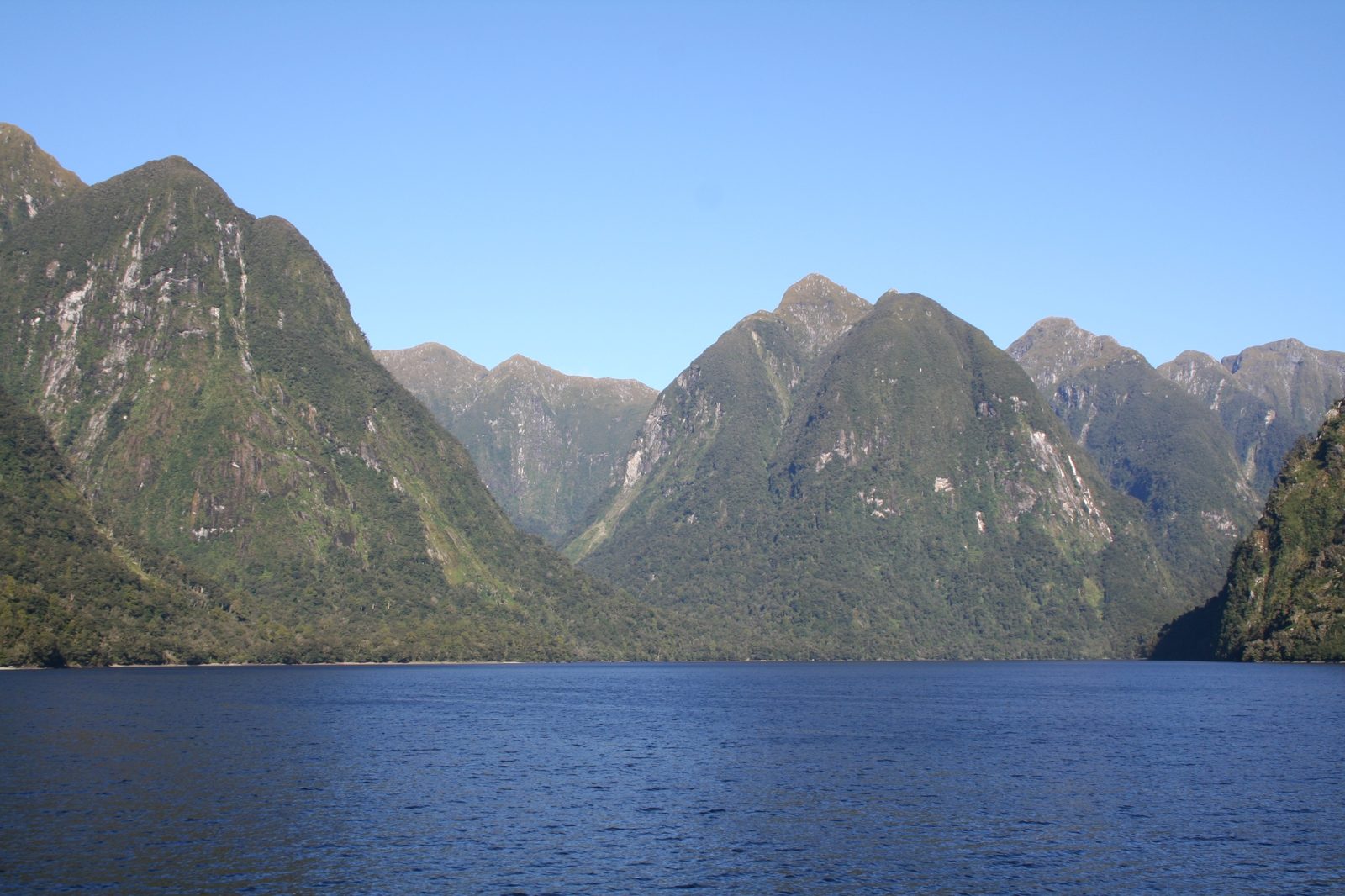
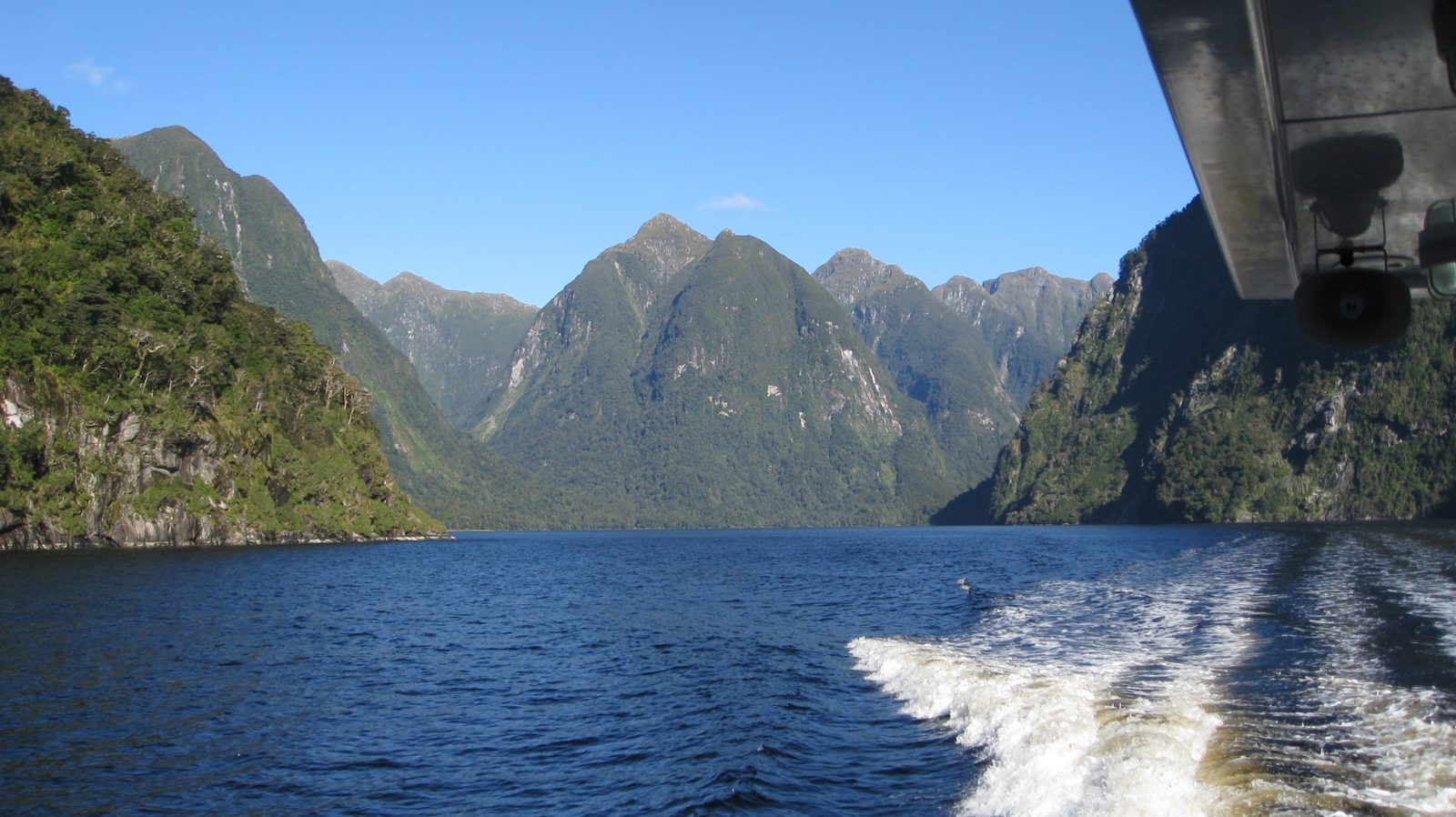
We booked ourselves on a tour of Doubtful Sound and got up early to organise lunch for a trip which was to last all day. We started with a boat ride across the lake and then boarded coaches to take us deep underground to the power station. The power station supplies electricity to an aluminium smelting plant outside Invercargilk. This aluminium plant provides top quality aluminium that is found in up market cameras. When the facility was built the tails to the turbines were found to be insufficient and the plant could not produce the designed power, so the tails needed to be enlarged. We returned to the coaches for a 45minute journey on a road built especially for the construction of the power station and embarked on another tourist boat. Whilst we sat at our own table and had lunch, we watched the most incredible scenery go by. We saw dolphins and motored out to an island where there was a colony of sea lions. All-in-all a most amazing day through achingly beautiful countryside.
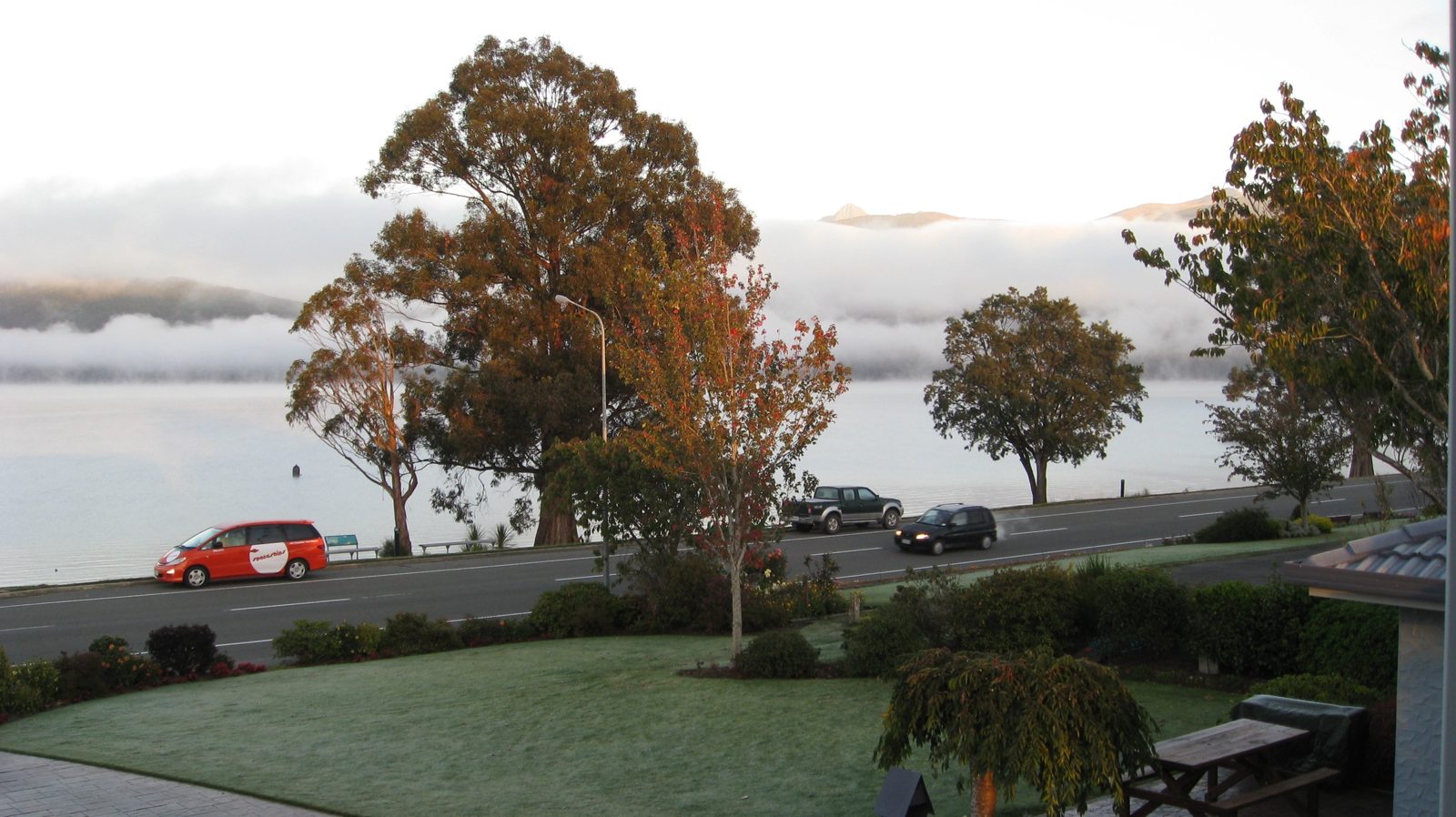
Winter is coming! There was frost on the car in the morning and on the ground and the lake was covered with morning mist with just the mountains visible above. It is time to go north again. We have driven through the most indescribably beautiful country and after having lunch just outside Queenstown we drove through the vineyards of central Otago and onwards towards Fox Glacier where we night stopped.
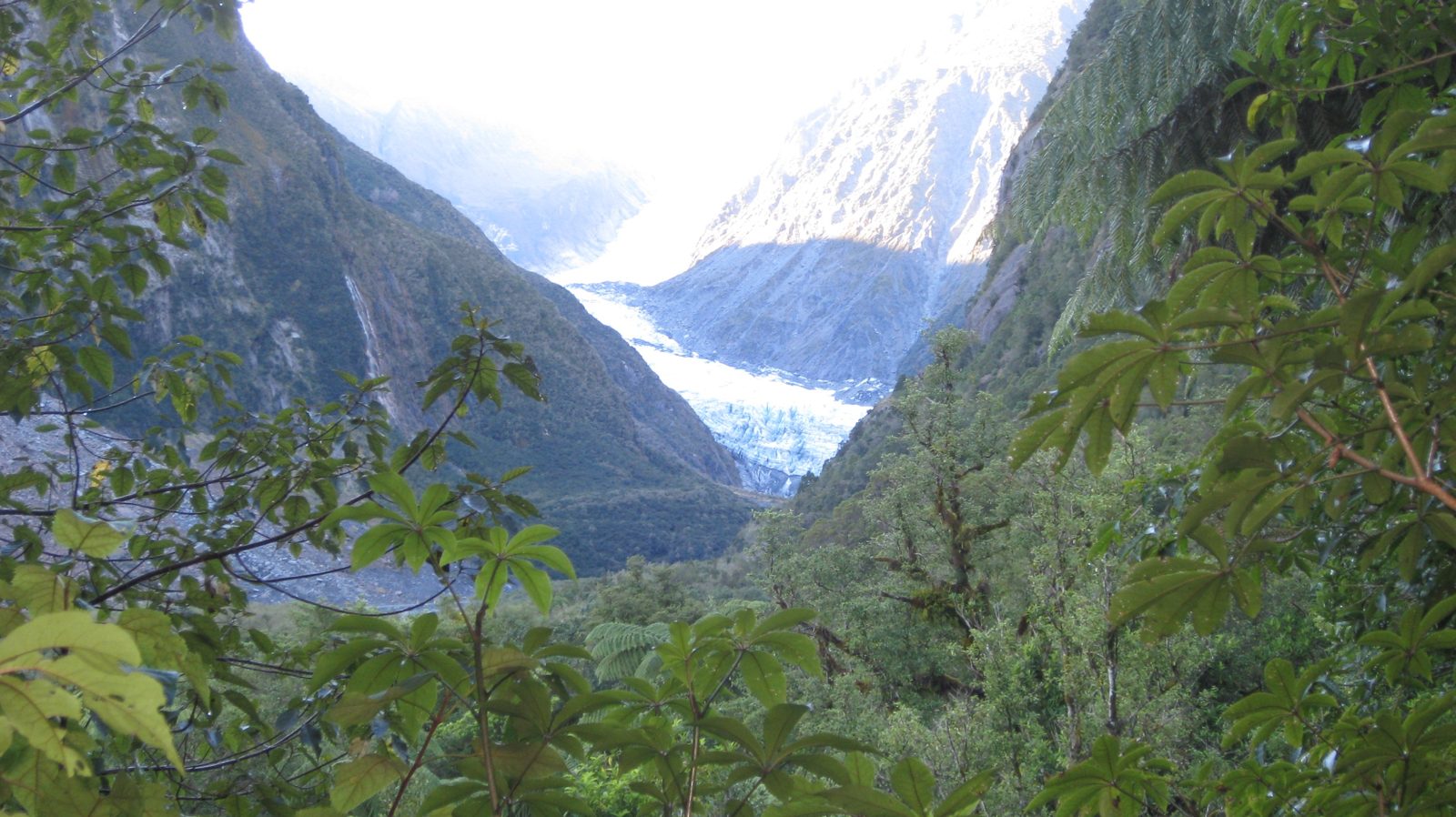
We woke up to another glorious cool and crisp morning with blue skies and frost on the ground. We drove out of the village to the west so we could look back up at Mount Cook and the Fox Glacier. It was an incredible sight - snow-covered peaks with the glaciers tumbling down the mountain. Once again, just more amazing countryside as we drove past Franz Joseph glacier and continued north before we turned east to cross Alfred's Pass. This time it was in beautiful sunshine. It is just an amazing wilderness that seems to go on and on with high mountains and valleys all around. There are occasional ski areas but essentially the fields were full of cattle and sheep. This is where the Lord of the Rings was filmed.
The following day we spent exploring Christchurch. We visited the cathedral and lit a candle for Sarah’s brother-in-law, Tony and passed the old university buildings which reminded us of an Oxford or Cambridge college. We passed through a porter's lodge into a quad and then continued on to the Botanic Gardens. It is always amazing, that the original founders had such vision to plant so many beautiful trees as well as planning the layout of the gardens and also, of course the city, which makes it so attractive today.
The drive up to Blenheim via Karkura was again outstanding. It was not so rugged but was equally as beautiful, the road followed the coastline for a lot of the time as did the railway line. Blenheim, however, was very disappointing. It is situated on a plain surrounded by hills and mountains and of course mile upon mile of vineyards, many of which we were very familiar with. We had lunch at Alan Scott's vineyard restaurant in a lovely building. It was a little chilly, so we sat inside and had dukkha for the first time. We went on to visit the first world war air museum, which was fascinating, and then drove back via Picton along the Queen Charlotte scenic Route to Nelson. We have driven 2770 km in eight days what a wonderful trip!
The following day was 25 April, Anzac Day. From then until we left Nelson on 4 May we spent our time pottering around the city and completing the numerous tasks around the boat. The pumps were giving me a real headache, and, in the end, I replaced the bilge pump with a submersible pump. The shower and sink discharge pumps were showing signs of wear, but I eventually refurbished them successfully.
It was amusing to have to describe how to replace the ballcock in the water storage tank in the airing cupboard of our Weybridge flat. Tom had advised that the overflow was causing the outside wall to be permanently wet. Now Tom would be the first to agree that he has no interest whatsoever in DIY, so we were delighted when he rang to say he had managed to fix the problem and replace the valve.
We returned the hire car once we had loaded provisions for our trip northbound and saw that we had completed 3775 km over the hire period of five weeks and three days. We were able to speak to Gemma and Annabel, Gemma getting a little tired as she approaches the end of her pregnancy and Annabel who had completed a sky diving jump from 12,000 feet. We were grateful to hear this after she had done it rather than before!
The weather during this period was autumnal to say the least. Several days of grey skies, strong winds and heavy rain persuaded us that we needed to set off back to Wellington. After all, the rules for foreign yachts meant that we had to leave New Zealand by the end of June, so there was a considerable distance to sail in a relatively short order.
The forecast for the Cook Strait was for the wind to become light and so we departed Nelson Marina leaving behind the delightful, friendly, and helpful marina staff. We completed the 127 miles to Wellington, motoring throughout overnight, in light winds. Once we had bunkered 600lts of fuel we returned to the hammerhead on pontoon B in Chaffers marina. It was six weeks to the day since we left Wellington.
Once again, we found we had to hide from the weather. There was intermittent heavy rain and strong winds with only short periods of sunshine. We pottered around Wellington whilst listening regularly to the forecast, but it was not until Tuesday, 12 May, that the forecast looked good enough to depart. We left Wellington mid-morning and had a bumpy ride down the Cook Strait but once round Cape Palliser it was much more comfortable. We were accompanied by quite a few albatrosses. They are such beautiful birds, and our final send- off was by a pod of dolphins who were busy fishing and leaping into the air.
Needless to say, that once we got around Castlepoint, the seas got rougher and a north-westerly gale set in. This was no fun - it is really sailing at its worst, but as we passed Gisborne the wind abated, so we decided to stop at Tolego Bay to have a rest, a good sleep, and a meal. We stayed here for a day completing little jobs including replacing the port navigation light and sorting out the leaking hatch in the saloon and forward cabin.
Departing to Tolego Bay on a good forecast and slight sees made us optimistic that we might make a good passage to Hicks Bay. However, by early afternoon the wind and sea picked up to give us the most uncomfortable ride around East Cape and on to Hicks Bay. I was having to drain the racor every half hour as water was gaining access to the diesel tank. This process required the engine to be stopped, the water drained from the racor, the filter bowl replenished with diesel and the engine restarted. This took approximately five minutes during which time we were at the mercy of the wind and sea. Yuck! What a relief when we dropped anchor in Hicks Bay out of the sea and wind. The only bright side of this passage was that we caught a fish.
We spent a couple of days listening to the weather forecasts. There was 60kt of wind in the Cook Strait, so we were very pleased to be here, and although we were comfortable, we were alone in the bay. We concluded that nobody was as crazy as us! I spent an hour or so pumping out the fuel tank and was amazed at the amount of filth that came out and decided to clean the tank once we had arrived in Whangerai.
At last, the forecast indicated a reasonable weather window and we left Hicks Bay mid-morning on 18 May and set off across the Bay of Plenty.
No surprise that the weather turned against us as soon as we rounded Cape Runaway and we motor-sailed for 12 hours before the wind came around and enabled us to sail. The sea was quite rough and so we decided to overnight in Tryphena Harbour on the Great Barrier Island. We ended up staying here for two days hiding from the weather, protected and quite comfortable. Once we left, we had an eight-hour sail to get to a Urquharts Bay, just behind Bream Head where we anchored to await the tide so we could get up to Whangerai. We needed 100 m of chain out due to poor holding and in recovering it, a piece of the windless broke off. Another unexpected expense! We woke up to a beautiful sunny morning and it felt quite warm until you got into the wind. After lunch we gently motored up the river on the tide to reach the Town Basin - by then it was raining quite hard of course! The marina was comparatively empty compared to when we left, as lots of the foreign yachts had already departed for warmer climes. We however, had much to do before we could follow.
We knew that we would have a great deal of busy activity to prepare for our departure from New Zealand. In fact, it turned out that this would take three weeks. The first task was to empty the fuel tank and clean it and to fabricate a new filter because the original one had disintegrated. I made a stainless-steel box and filled it with stainless scorers which seemed to do the trick.
We were delighted that Jim and Diane off Prairie Oyster, last seen in Tonga, knocked on Moonbeam. They were planning to join us here prior to shipping their boat back to Mexico. They proved to be great companions throughout our stay here, with Sarah and Dianne exploring the town and shopping together.
We got Ronnie to look at the Bimini with the plan of engaging him to make a tent. Ronnie comes over as being rather simple, but he is definitely not: he is very chatty and knowledgeable. At the same time Pelle took the sails off in order to inspect them and to make repairs as necessary. Meanwhile I fixed the navigation lights and took the engine injectors to be serviced, and which when returned and fitted gave me great delight when the engine started and ran smoothly.
Having repaired and refurbished the windlass I was able to weld the 40 m of new anchor chain to our existing chain, and we then were able to recover the entire 120 m back into the anchor locker. I used our new purchase of a pressure washer to clean the chain as it was brought aboard, as it had been sitting in the mud at the bottom of the river for a week. I have no doubt that the washer will be well used in due course.
We located a new Iridium Satellite Phone in Auckland and decided we would take a trip in our hire car to obtain charts for Vanuatu and Australia and to purchase the new sat phone.
Jim and Diane came with us. We discovered that they had never experienced dim sum when we had lunch because Jim thought that he should take something from everything that came past us! What fun.
The days were passing quickly and whilst I installed the new sat phone, Ronnie finished the cockpit tent. He was kind enough to give us a book. It was entitled ‘Endeavour’ which turned out to be a description of Captain Cook's voyage. Pelle returned the sails and helped to bend them on, and I decided to clear out the lazarette.
Now we had been concerned that our medical kit had drugs in it that were time expired. I took it to a pharmacy, but the pharmacist explained that as many of the drugs contained in it were prescription drugs, the easiest way to replace them was to see a doctor. There was a scheme by which a skipper of a boat could get prescription drugs for the boat medical kit, but it was time consuming and complicated. He suggested going to see a doctor who turned out to be a dermatologist but was a keen sailor. I made an appointment accordingly.
Well, I spent an hour with the doctor. He was practical and helpful and went through the medical kit and provided prescriptions for those items that needed replacement. He then quizzed me on many aspects of injury and associated first-aid. For instance, he asked me why I would use an EpiPen. I replied for severe allergic reaction. Good he said – what are you going to do now? As I didn’t know, he supplied injectable antihistamine because it was unlikely that I would be able to get the casualty to hospital. He enquired what analgesics we had on board and prescribed morphine because he recognised that Panadol might not be sufficient! He asked me how good I was at suturing, and when I told him I had practised using an orange, he laughed and described the situation where the boat was moving about in a gale and a severe wound had to be sewn. He declared that I needed a stapler and provided one. This was to prove one of the best hours of education spent in New Zealand!
I wanted to get rid of some of the old warps, halyards and sheets which were never going to be used again, alongside the old anchor chain that I had just replaced. So, I put all these on the pontoon with a sign that Jim from Prairie Oyster made which said ‘Free - help yourself’. Within an hour they were all gone! Meanwhile, Sarah had stocked up ready for our departure and we departed the Town Basin Marina in the afternoon of Sarah's birthday, 13 June. Jim and Diane were on the dock to help us with lines. It was sad to leave them because they had become really good friends. They are a lovely couple. Jim’s parting shot was to offer to crew Moonbeam from Cape Town! We motored down to Marsden Point Marina where we bunkered 720 L of fuel and recognised that there was still an awful lot to do before we ready to leave and check-out the following day.
However, the wind came up overnight, and it was not very protected in the marina. Consequently, we decided to wait until the weather improved. This was a good decision, because it allowed us to put things away and sort out all the odds and ends that we had not got around to prior to leaving Whangerai. So, on Monday, 15 June we moved to the Customs wharf and were checked out by Bruce, who was the customs officer who had checked us into New Zealand nine months ago. We left the marina at 1115L and said farewell to New Zealand and to start our journey home……